Connect Claude Desktop to LiteLLM
Claude Desktop on third-party inference sends every model call from Cowork, Chat, and Code sessions to a gateway you name, and reaches MCP servers through the same gateway. This page is the quickest path: one device, a static virtual key, configured from the app. For single sign-on through your identity provider, the model picker rules, and rolling the configuration out to a fleet, see Claude Desktop (Cowork).
Quick reference
| Setting | Value |
|---|---|
| Inference provider | Gateway |
| Gateway base URL | <LITELLM_PROXY_BASE_URL> (e.g. http://localhost:4000) |
| Gateway API key | Your LiteLLM virtual key, auth scheme Bearer |
| MCP endpoint | <LITELLM_PROXY_BASE_URL>/mcp, or <LITELLM_PROXY_BASE_URL>/<server_name>/mcp for one server |
| MCP auth header | x-litellm-api-key: Bearer <virtual key> |
LLM setup
1. Enable Developer Mode
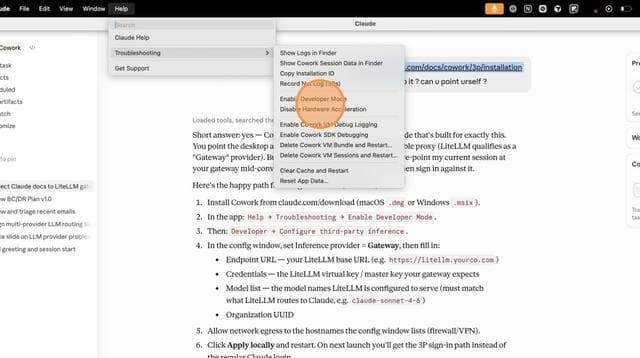
In Claude Desktop, open Help -> Troubleshooting -> Enable Developer Mode.
2. Open Configure Third-Party Inference
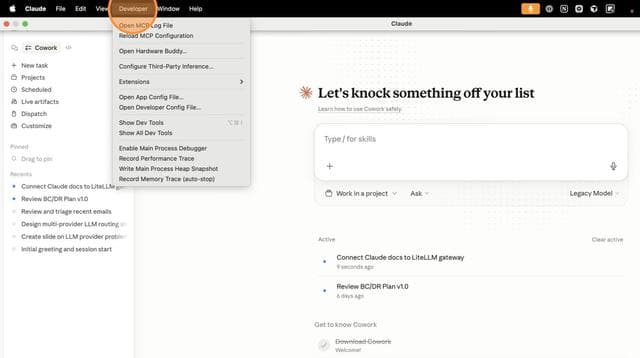
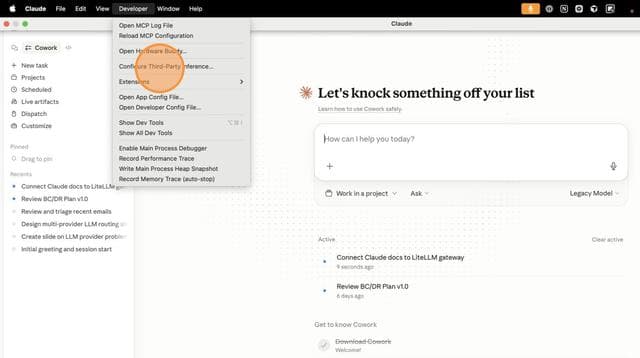
Open the Claude menu, click Developer, then Configure Third-Party Inference...
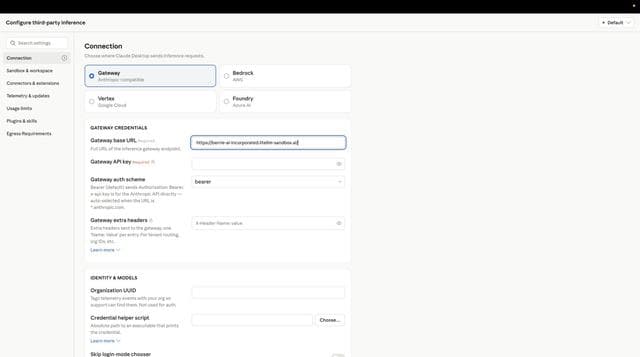
3. Enter your gateway URL and virtual key
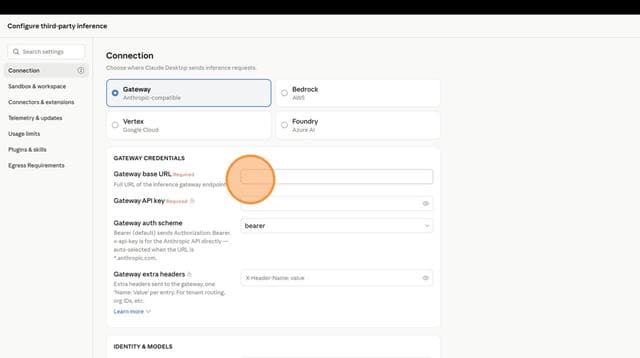
In the Connection section set Inference provider to Gateway, put your LiteLLM proxy URL in Gateway base URL and your virtual key in Gateway API key, and leave Gateway auth scheme at bearer (LiteLLM also accepts x-api-key). Click Apply Changes (called Apply locally in older versions).
Create the virtual key from the Admin UI under Virtual Keys -> + Create New Key if you do not have one. Scope it to the Claude models and give it a max_budget; everyone using the same key shares that budget.
4. Verify
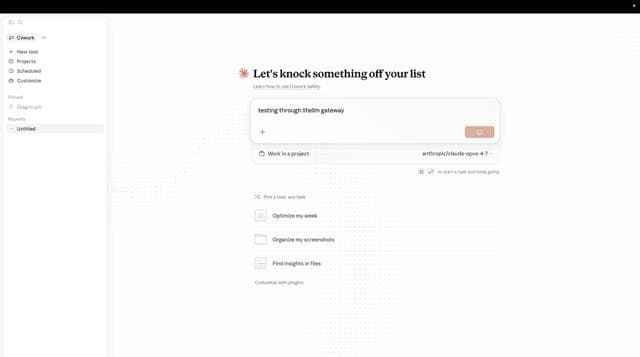
Restart Claude Desktop. The model picker is built from GET /v1/models on your gateway and keeps the model_name values that contain claude or anthropic, so name your deployments accordingly. Start a task, then confirm the request in the Admin UI under Logs or Usage, attributed to your virtual key.
MCP setup
The MCP screenshots below use Claude Desktop 2.2553.13 on Linux and a local demonstration gateway. Menu labels can differ by app version.
1. Add the gateway connector
Open Configure Third-Party Inference and find Connectors. Add a server named litellm, select Streamable HTTP, and enter http://localhost:4000/mcp as the URL. Replace the base URL with your gateway address. This endpoint exposes the servers your key can access.
Set the header x-litellm-api-key to Bearer <your virtual key>. Grant the key access to that MCP server as described in the overview. In the exported configuration, this is an entry in managedMcpServers:
[
  {
    "name": "litellm",
    "transport": "http",
    "url": "http://localhost:4000/mcp",
    "headers": {"x-litellm-api-key": "Bearer sk-<your-virtual-key>"}
  }
]
2. Test the connection
Click Sign in & test (called Test this connection in some versions). Claude runs MCP initialization and tool discovery with the URL and credentials you entered, then displays the discovered tools or a connection error. Check that the tools belong to the intended server before saving the configuration.
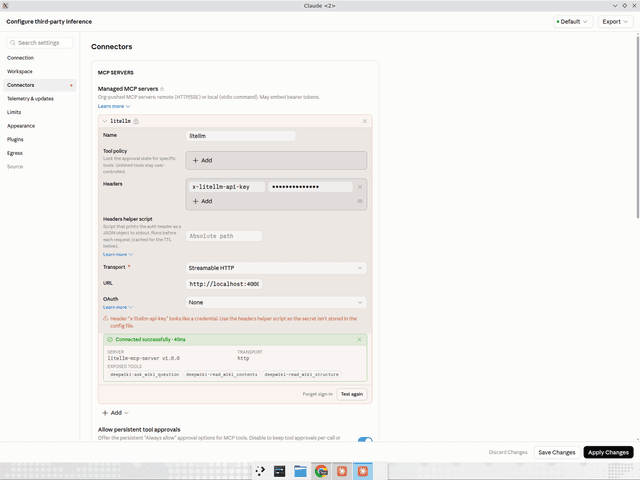
Use your own virtual key in this field. Claude may flag a static authentication header as credential-like. For managed deployments, the advanced guide covers a credential helper instead.
3. Verify in Cowork
Apply the configuration and restart Claude Desktop. Start a Cowork task that uses a read-only tool from the connector, approve it if prompted, and check that the tool returns a result. Tools use the <server>-<tool> naming convention.
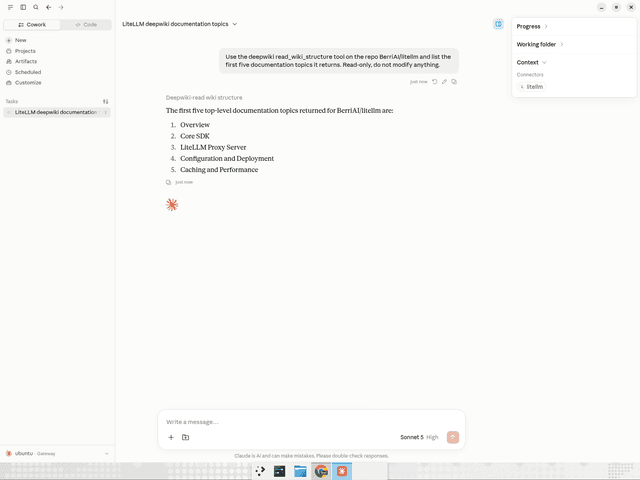
To select one server, use /<server_name>/mcp instead. The MCP configuration reference covers endpoint selection, server filtering, and authentication.
Claude Desktop's built-in connectors (github, microsoft365, websearch) run inside the app against those vendors' APIs and never pass through LiteLLM; only url entries do. For servers that need the user's own upstream login, set "oauth": true on the per-server URL and let LiteLLM run the flow; see MCP OAuth passthrough. The full guide covers headersHelper for single sign-on fleets and per-tool policies.
Next steps
Claude Desktop (Cowork) for SSO, model picker rules, fleet rollout, and troubleshooting; Auto Router with Claude Code and Claude Desktop; MCP gateway reference.