Claude Code Gateway (SSO sign-in)
Let developers sign in to Claude Code with your SSO provider instead of an API key. LiteLLM serves the same gateway protocol Anthropic's self-hosted Claude apps gateway speaks: Claude Code's /login opens on a Cloud gateway screen, the developer signs in through your identity provider in the browser, and every request after that carries a LiteLLM token tied to that developer's user and team, so spend, budgets, and logs are attributed per person with nothing to issue or rotate
SSO requires a LiteLLM Enterprise license. Start a free 30-day trial or book a demo. See what Enterprise includes.
From v1.76.0, SSO is free for up to 5 users. Beyond that, an enterprise license is required.
The flow works with any SSO provider LiteLLM supports (Google, Microsoft Entra ID, Okta, or any OIDC provider through the generic client). It differs from Claude Code with Okta SSO (JWT Auth), where a helper script fetches an IdP token and Claude Code sends that token as its API key: here there is no script to distribute, the sign-in is Claude Code's own, and the proxy can push managed settings to every signed-in client. Claude Code v2.1.195 or later is required on developer machines
How it works
Claude Code reads the gateway URL from a managed settings file, fetches the gateway's OAuth discovery document, and asks the developer once to trust the gateway. It then starts an OAuth device authorization flow: the terminal shows a short code and opens the browser on LiteLLM's SSO login, the developer signs in with your identity provider and confirms the code, and Claude Code, which has been polling the token endpoint, receives a LiteLLM CLI token and a refresh token. The CLI token is a JWT scoped to the developer's user and team, valid for 24 hours by default, and Claude Code renews it with the refresh token before it expires, so a developer who keeps using Claude Code is not sent back to the browser (see Session lifetime and sign-out). Claude Code stores both, fetches managed settings with the CLI token, and sends every inference request to /claude_code_gateway/v1/messages with it as the bearer token. Under the hood the gateway reuses the proxy's existing CLI SSO device flow, so anything that works for lite login (SSO providers, team membership, model access, budgets) works here
1. Turn the gateway on
Enable the gateway in general_settings. The anthropic/* wildcard matters: Claude Code asks for model names by itself (claude-opus-4-7 for the current release), so the proxy needs to resolve whatever it sends, and a named alias next to it gives you a stable name to grant on teams
model_list:
  - model_name: claude-sonnet-5
    litellm_params:
      model: anthropic/claude-sonnet-5
      api_key: os.environ/ANTHROPIC_API_KEY
  - model_name: "anthropic/*"
    litellm_params:
      model: "anthropic/*"
      api_key: os.environ/ANTHROPIC_API_KEY

general_settings:
  master_key: os.environ/LITELLM_MASTER_KEY
  database_url: os.environ/DATABASE_URL
  enable_claude_code_gateway: true
The browser leg is the proxy's SSO login, so configure your SSO provider the way SSO for Admin UI describes and register <proxy base url>/sso/callback as the redirect URI. For Google that is two variables; Microsoft, Okta, and generic OIDC have their own set on that page
export GOOGLE_CLIENT_ID="<client id>"
export GOOGLE_CLIENT_SECRET="<client secret>"
export PROXY_BASE_URL="https://litellm.internal.example.com"
litellm --config config.yaml
PROXY_BASE_URL is the origin developers reach. The gateway builds the discovery document, the token endpoint, and the browser verification URL from it, so behind a load balancer or TLS terminator it must name the public-facing origin, not the pod. Claude Code only signs in to a gateway whose hostname resolves to private addresses (RFC 1918, link-local, CGNAT 100.64.0.0/10, IPv6 ULA fc00::/7, or loopback), because a trusted gateway can push settings that run commands on developer machines. Put the proxy on an internal hostname behind TLS; the CLI pins the TLS certificate per hostname on first connect. Plain http:// on loopback, as in the screenshots below, is accepted for local testing
Two optional settings tune the flow. LITELLM_CLI_JWT_EXPIRATION_HOURS sets the session token's lifetime between renewals (default 24). Claude Code renews the session token with the refresh token before it expires, so a developer stays signed in past that lifetime. A session ends when 14 days pass without a renewal, when a renewal is refused, or when the developer runs /logout (see Session lifetime and sign-out). Keep it at or below 336, since a session token that lives longer than the 14-day refresh token outlives the token that would renew it, and the developer is back to /login when it expires. allow_cli_sso_verification_uri_complete: true under general_settings adds verification_uri_complete to the device authorization response, which carries the code in the URL so a client that honors it opens the browser page with the code already filled in. It is off by default because typing the code is what ties the browser page to the terminal that started the login; see Pre-fill the verification code
With more than one worker or replica, the browser leg and the terminal's polling can land on different processes, and the sign-in state lives in the proxy's CLI SSO cache. The record of which refresh tokens were already used or revoked lives in the proxy's cache too, and a process that never saw that record accepts a refresh token another process already rotated or revoked. Configure Redis (REDIS_HOST, REDIS_PORT, and REDIS_PASSWORD in the environment, or general_settings.coordination_redis) so that cache is shared, or run a single worker. While Redis is unreachable a renewal or a sign-out answers 503 temporarily_unavailable rather than guessing, and Claude Code keeps using the session token it has and renews again later
2. Verify from the command line
The discovery document is served without authentication. The issuer is the URL to put in every developer's managed settings file in the next step
curl http://localhost:4000/claude_code_gateway/.well-known/oauth-authorization-server
{
  "issuer": "http://localhost:4000/claude_code_gateway",
  "device_authorization_endpoint": "http://localhost:4000/claude_code_gateway/oauth/device_authorization",
  "token_endpoint": "http://localhost:4000/claude_code_gateway/oauth/token",
  "revocation_endpoint": "http://localhost:4000/claude_code_gateway/oauth/revoke",
  "grant_types_supported": ["urn:ietf:params:oauth:grant-type:device_code", "refresh_token"]
}
Starting a device authorization by hand shows what Claude Code sees at /login: a code for the developer, the browser URL, a ten-minute window, and a five-second polling interval
curl -X POST http://localhost:4000/claude_code_gateway/oauth/device_authorization
{
  "device_code": "cli-tyQu2vOB-r2ynASXPqyOKDd0g_cr6NOm.mAVkxaITywoFfMB-_x87HqgyZ886Hz6luXiZw2qssVo",
  "user_code": "XPCA-X2K2",
  "verification_uri": "http://localhost:4000/sso/key/generate?source=litellm-cli&key=cli-tyQu2vOB-r2ynASXPqyOKDd0g_cr6NOm",
  "expires_in": 600,
  "interval": 5
}
Polling the token endpoint before the browser sign-in has finished answers authorization_pending, which is what Claude Code waits on
curl -X POST http://localhost:4000/claude_code_gateway/oauth/token \
  -d grant_type=urn:ietf:params:oauth:grant-type:device_code \
  -d device_code="cli-tyQu2vOB-r2ynASXPqyOKDd0g_cr6NOm.mAVkxaITywoFfMB-_x87HqgyZ886Hz6luXiZw2qssVo"
{"error": "authorization_pending"}
Once the developer has approved the code in the browser (the next section shows that leg), the same poll answers the session token with a refresh token next to it, served with cache-control: no-store. expires_in is LITELLM_CLI_JWT_EXPIRATION_HOURS in seconds, and user_id and team_id name the user and team the session is scoped to
{
  "access_token": "litellm_login_<redacted>",
  "token_type": "Bearer",
  "expires_in": 86400,
  "refresh_token": "llm_srefresh_e<redacted>",
  "user_id": "<the signed-in user id>",
  "team_id": "<the first team on the user record, or null when it has none>"
}
Renewal is the refresh_token grant on the same endpoint, with no client_id, which is exactly what Claude Code sends. The response has the same shape with a new session token and a new refresh token, and the refresh token just presented is spent
curl -X POST http://localhost:4000/claude_code_gateway/oauth/token \
  -d grant_type=refresh_token \
  -d refresh_token="$REFRESH_TOKEN"
A refresh token presented a second time, one that was revoked, or a value that was never a refresh token answers 400 invalid_grant
{
  "error": "invalid_grant",
  "error_description": "the refresh token was already used"
}
Sign-out is RFC 7009 revocation on the revocation_endpoint. /logout posts the session token and the refresh token there, one request each. Revoking the refresh token is what ends the sign-in; the session token is stateless and expires on its own, so its request changes nothing. The endpoint answers 200 with {} whether or not it recognizes the token, so calling it twice is safe
curl -X POST http://localhost:4000/claude_code_gateway/oauth/revoke \
  -d token="$REFRESH_TOKEN" \
  -d token_type_hint=refresh_token
3. Point Claude Code at the proxy
Claude Code opens /login on the gateway screen only when the gateway URL comes from a managed settings file. Those keys are ignored in a developer's own ~/.claude/settings.json, so deploy this file through your device management tooling or write it directly: /Library/Application Support/ClaudeCode/managed-settings.json on macOS, /etc/claude-code/managed-settings.json on Linux and WSL, C:\Program Files\ClaudeCode\managed-settings.json on Windows
{
  "forceLoginMethod": "gateway",
  "forceLoginGatewayUrl": "https://litellm.internal.example.com/claude_code_gateway"
}
The URL is the issuer from the discovery document, with the /claude_code_gateway path. If developer machines route HTTPS through a corporate proxy, add the LiteLLM host to NO_PROXY so the CLI connects to it directly, and if your internal network is numbered from public IPv4 space you own, list those blocks in the gatewayInternalNetworks managed setting (Claude Code v2.1.268 or later); both are covered in Anthropic's gateway prerequisites
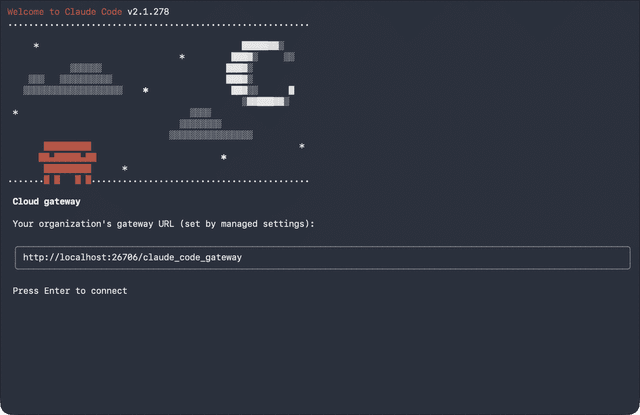
With the file in place, run claude (or /login in a running session). The gateway screen shows the URL from managed settings
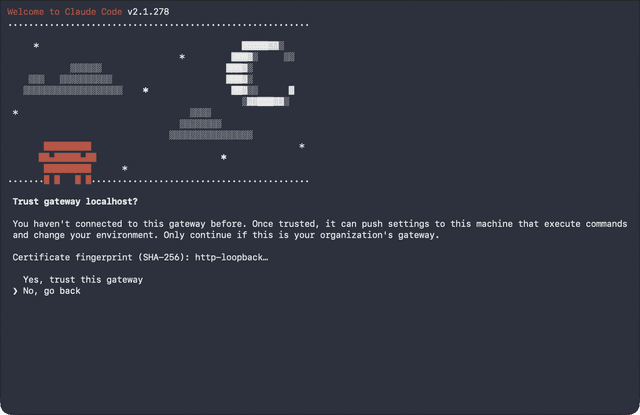
On the first connection Claude Code asks the developer to trust the gateway, since a trusted gateway can push settings to the machine. This is asked once per gateway host
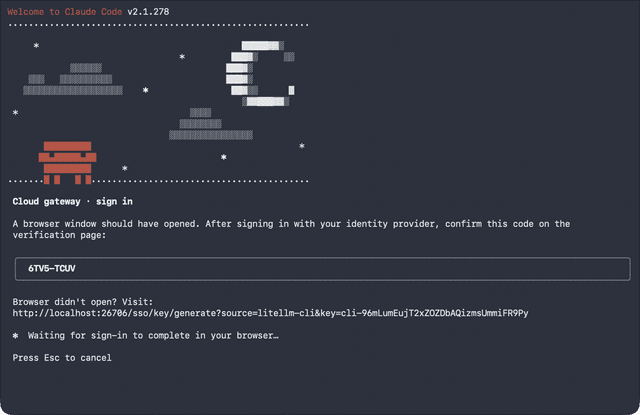
Claude Code then shows the verification code and opens the browser on the proxy's SSO login. If the browser does not open, the developer visits the URL shown
The browser goes through your identity provider (a browser already signed in to the provider lands on the next page without a prompt) and then asks for the code from the terminal
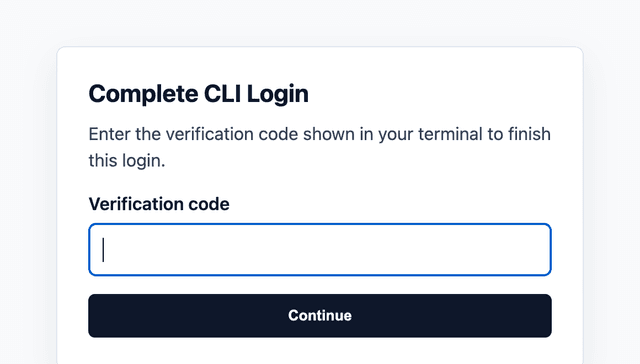
After Continue, the browser confirms the login and the terminal picks it up on its next poll
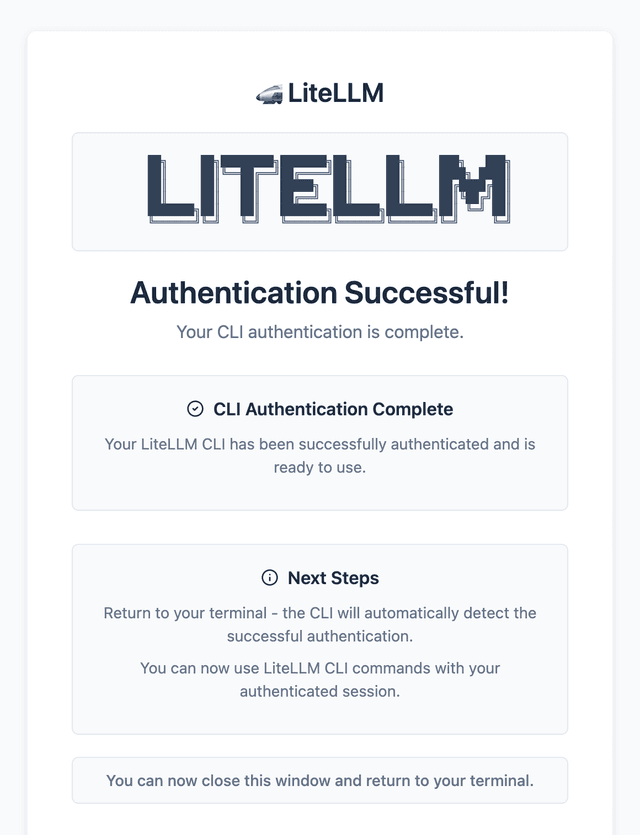
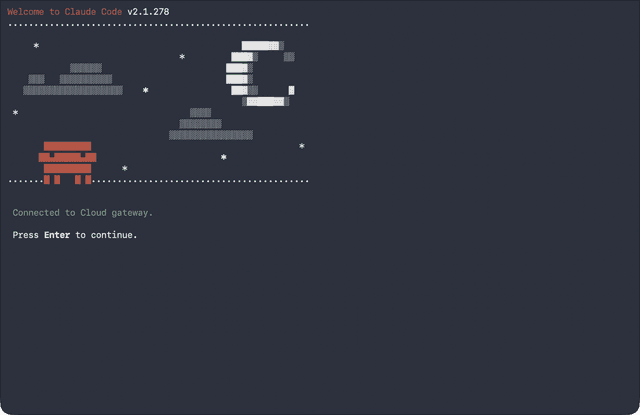
From here Claude Code continues with its usual first-run prompts (security notes and workspace trust) and lands on the prompt, showing Cloud gateway next to the model. Requests hit POST /claude_code_gateway/v1/messages on the proxy with the developer's token, and each one shows up in the proxy's logs and spend under that developer's user and team
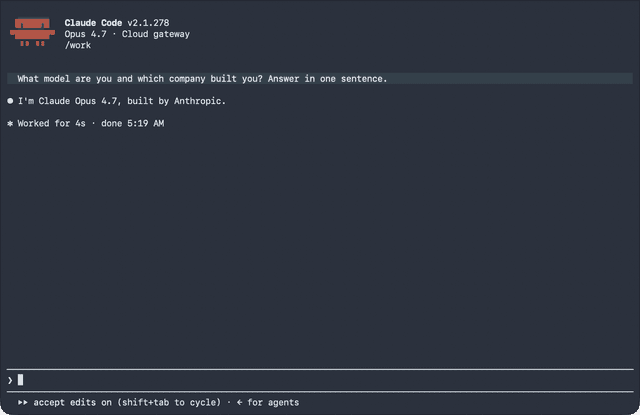
Session lifetime and sign-out
Claude Code stores the session token together with the refresh token. Five minutes before the session token expires (24 hours by default), it posts the refresh token to the token endpoint and stores the new session token and refresh token it gets back, so a developer who keeps using Claude Code is not sent back to the browser. Each refresh token is single-use and lives 14 days, and every renewal issues a new one, so a session ends after 14 days without a renewal, and Claude Code asks for /login once the session token it holds expires. Two Claude Code terminals on one machine share the stored credential but renew on their own, so the second one to renew presents the refresh token the first already rotated, is refused (one or more 400s on /claude_code_gateway/oauth/token in the proxy's access log) and carries on with the credential the first terminal saved
Every renewal re-reads the developer's user record and team membership in LiteLLM. Deactivating or deleting the user in LiteLLM, or removing them from the team the session was issued for, refuses the next renewal with 400 invalid_grant, and Claude Code asks for /login once the current session token expires, within LITELLM_CLI_JWT_EXPIRATION_HOURS. A deleted user's requests to /claude_code_gateway/v1/messages answer 401 right away, before that session token expires. Deprovisioning a developer at the identity provider alone does not end a session in progress, because renewal checks LiteLLM's own user and team state and not the identity provider, so that session keeps renewing until 14 days pass without a renewal. Deactivate the user in LiteLLM as well to end it sooner
/logout posts the session token and the refresh token to POST /claude_code_gateway/oauth/revoke, the revocation_endpoint from the discovery document, then removes the stored credential. Revoking the refresh token ends that sign-in, since every refresh token rotated from it, whoever holds one, is refused from then on. The session token itself is self-contained and is not revoked; it stays valid until it expires
Renewal and revocation need LiteLLM v1.106.0 or later (first in v1.106.0-rc.1). Earlier releases issue no refresh token and answer every refresh with 401, so Claude Code asks for /login again at every expiry, and during a rolling upgrade a renewal served by a replica still on the previous release does the same for that developer once
4. Push managed settings from the proxy
Anything you put under claude_code_gateway_managed_settings is served verbatim as the organization's managed settings to every client signed in through the gateway. The value is a Claude Code managed settings document, so the same keys work: permissions, env, hooks, allowed tools, and so on. Claude Code fetches it at startup and again every hour, and locked keys cannot be overridden locally
general_settings:
  enable_claude_code_gateway: true
  claude_code_gateway_managed_settings:
    permissions:
      defaultMode: acceptEdits
    env:
      CLAUDE_CODE_ENABLE_TELEMETRY: "1"
      OTEL_METRICS_EXPORTER: otlp
      OTEL_LOGS_EXPORTER: otlp
      OTEL_EXPORTER_OTLP_PROTOCOL: http/protobuf
      OTEL_EXPORTER_OTLP_ENDPOINT: https://litellm.internal.example.com/claude_code_gateway
The endpoint is GET /claude_code_gateway/managed/settings, authenticated with the CLI token (any LiteLLM key works for checking it). The response wraps your block in the {uuid, checksum, settings} envelope Claude Code expects, where both ids are the SHA-256 of the canonical JSON, and the same value is returned as an ETag. Claude Code sends it back as If-None-Match on the hourly refresh and gets 304 Not Modified until the block changes. When claude_code_gateway_managed_settings is unset, the endpoint answers 404, which the CLI reads as "no managed policy"
curl -s http://localhost:4000/claude_code_gateway/managed/settings \
  -H "Authorization: Bearer $LITELLM_KEY"
{
  "uuid": "sha256:c74c6a3f7f6bfda0c71ded0a60e3f1669b61f86f5ef603291fd39be2fea600a5",
  "checksum": "sha256:c74c6a3f7f6bfda0c71ded0a60e3f1669b61f86f5ef603291fd39be2fea600a5",
  "settings": {
    "permissions": {"defaultMode": "acceptEdits"},
    "env": {
      "CLAUDE_CODE_ENABLE_TELEMETRY": "1",
      "OTEL_METRICS_EXPORTER": "otlp",
      "OTEL_LOGS_EXPORTER": "otlp",
      "OTEL_EXPORTER_OTLP_PROTOCOL": "http/protobuf",
      "OTEL_EXPORTER_OTLP_ENDPOINT": "https://litellm.internal.example.com/claude_code_gateway"
    }
  }
}
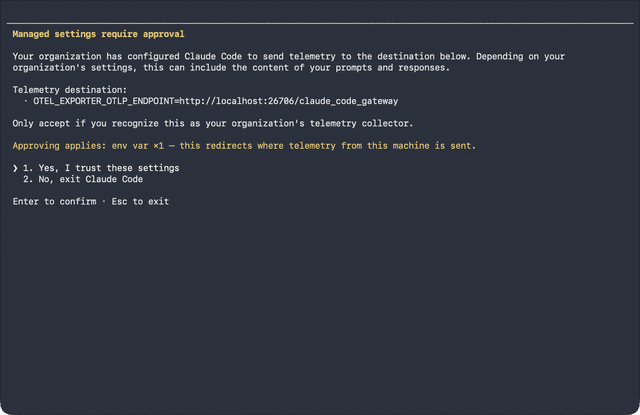
Some settings need the developer's approval the first time they apply. A telemetry destination is one of them: Claude Code shows where telemetry will go and applies the block only once the developer accepts, so tell your developers to expect this screen
5. Telemetry
In sessions signed in through /login, Claude Code sends its OpenTelemetry exports (OTLP over HTTP; gRPC is not supported on gateway sessions) to the gateway rather than to a locally set OTEL_EXPORTER_OTLP_ENDPOINT, unless a managed setting names another collector. The env block above turns the exporters on and points them at the proxy, which serves POST /claude_code_gateway/v1/metrics, /v1/logs, and /v1/traces, authenticated with the same token, and answers 200. Today the proxy accepts these exports and discards them; per-request usage, spend, and logs come from the proxy's own logging on /claude_code_gateway/v1/messages, not from the OTLP stream. If you already collect Claude Code telemetry, set OTEL_EXPORTER_OTLP_ENDPOINT in the managed settings to your collector instead
Deployment topologies
Claude Code to LiteLLM. The setup on this page: developers sign in through LiteLLM, LiteLLM holds the provider credentials, and the proxy's model access, budgets, rate limits, and logging apply per user and team. This is the topology to pick when LiteLLM is already your gateway for other clients
Claude Code to LiteLLM behind a load balancer. The same thing with several replicas: PROXY_BASE_URL names the balancer's origin so the discovery document and the browser URL point developers at an address they reach, TLS terminates at the balancer on a private hostname, and Redis is configured so the device flow completes on any replica. Sticky sessions are not needed
Claude Code to the Claude apps gateway to LiteLLM. Anthropic offers no hosted gateway; the Claude apps gateway is software you run yourself. If you already run it (for its IdP-group policies, or because Claude Desktop connects through it), it can front LiteLLM as an anthropic upstream whose base_url is the proxy and whose api_key is a LiteLLM virtual key. Set forward_user_identity: true on that upstream and the Claude apps gateway adds x-litellm-end-user-id (the developer's email) to every request it forwards; LiteLLM reads that header as the customer id without any extra configuration, so spend is tracked per developer even though the proxy sees one key. A 429 from LiteLLM on such a request is returned to the developer as-is instead of failing over to another upstream (Claude apps gateway v2.1.267 or later), so per-customer budgets and rate limits hold. In this topology the sign-in and managed settings are the Claude apps gateway's, and enable_claude_code_gateway stays off on LiteLLM
upstreams:
  - provider: anthropic
    base_url: https://litellm.internal.example.com
    auth:
      api_key: ${LITELLM_VIRTUAL_KEY}
    forward_user_identity: true
Known limits
Revocation covers the refresh token only. The session token is self-contained, so after /logout the session token a developer held keeps working until it expires, within LITELLM_CLI_JWT_EXPIRATION_HOURS
A replayed refresh token is refused on its own and ends nothing else, so a copy of a refresh token that renews before the real one keeps its chain alive. The real Claude Code drops its refresh token on that refusal, which leaves /logout nothing to revoke, so deactivating or deleting the user in LiteLLM, or removing them from the team, is what ends that chain
The refresh token is signed with the MCP gateway's session signing keys, derived from master_key unless general_settings.mcp_session_token_signing is set. On a proxy where that block cannot be loaded, sign-in still succeeds but returns no refresh token and the proxy logs the fault, so the developer is back to signing in at every expiry until it is fixed
The token is scoped to the first team on the developer's user record. A developer who belongs to several teams has no team picker in this flow and gets the first team's models and budget; lite login offers the picker if a developer needs a token for another team
Two endpoints of the protocol are not served: GET /claude_code_gateway/v1/models and HEAD /claude_code_gateway/api/hello answer 404. Sign-in, managed settings, and inference do not depend on them. Model discovery through /v1/models is off in Claude Code unless CLAUDE_CODE_ENABLE_GATEWAY_MODEL_DISCOVERY=1 is set, and with the endpoint unserved the /model picker shows Claude Code's built-in list, which is why the proxy config keeps the anthropic/* wildcard. The team's model list still decides which of those models a developer may use
enable_claude_code_gateway, claude_code_gateway_managed_settings, and allow_cli_sso_verification_uri_complete are read from general_settings in config.yaml only; they cannot be set from the Admin UI or the database
Claude Code disables server-side WebSearch on gateway sessions and uses the 5-minute prompt cache TTL rather than the 1-hour one, because it cannot see which upstream a gateway routes to. Both are Claude Code behaviors for any gateway, LiteLLM included
Related docs
- CLI SSO Authentication: the device flow the gateway reuses, token lifetime, the PKCE sign-in whose refresh token family and revocation this gateway reuses, and the native client contract
- SSO for Admin UI: configuring Google, Microsoft, Okta, or generic OIDC on the proxy
- Claude Code with Okta SSO (JWT Auth): the
apiKeyHelperalternative, where Claude Code sends the IdP token itself - Claude Code Quickstart: basic Claude Code with LiteLLM setup using an API key