Connect Claude Code to LiteLLM
Claude Code talks to the Anthropic Messages API. LiteLLM serves that format at /v1/messages, so two environment variables point Claude Code at the gateway and it works against any model in your config, not just Anthropic's.
Quick reference
| Setting | Value |
|---|---|
ANTHROPIC_BASE_URL | <LITELLM_PROXY_BASE_URL> (e.g. http://localhost:4000) |
ANTHROPIC_AUTH_TOKEN | Your LiteLLM virtual key |
ANTHROPIC_MODEL | A model_name from your config |
| MCP endpoint | <LITELLM_PROXY_BASE_URL>/<server_name>/mcp |
| MCP auth header | x-litellm-api-key: Bearer <virtual key> |
LLM setup
1. Point Claude Code at the gateway
Export the base URL, your virtual key, and the model, then launch Claude Code:
export LITELLM_API_KEY="sk-<your-virtual-key>"
export ANTHROPIC_BASE_URL="http://localhost:4000"
export ANTHROPIC_AUTH_TOKEN="$LITELLM_API_KEY"
export ANTHROPIC_MODEL="claude-sonnet-5"

claude
Claude Code sends every request to LiteLLM's /v1/messages endpoint with your virtual key as the bearer token. To make this permanent, add the exports to your shell profile (~/.zshrc, ~/.bashrc) or to the env block of Claude Code's settings.json. If ANTHROPIC_API_KEY is also set in your shell, unset it for this session so Claude Code does not send it instead of the virtual key.
2. Pick a model
Claude Code sends whatever model id is selected, so that id has to exist as a model_name on your gateway. ANTHROPIC_MODEL pins the default to one of your names. The /model picker inside a session still lists Anthropic's own ids (for example claude-haiku-4-5-20251001), so choosing one there fails with Invalid model name passed in unless your config also defines that exact name; either add those names to model_list or keep switching models through ANTHROPIC_MODEL. Route Claude Code to non-Anthropic models covers mapping the Sonnet, Opus, and Haiku tiers to any provider.
3. Verify
Send a prompt. Here Claude Code 2.1 is answering through a local gateway with ANTHROPIC_MODEL set to a model from model_list:
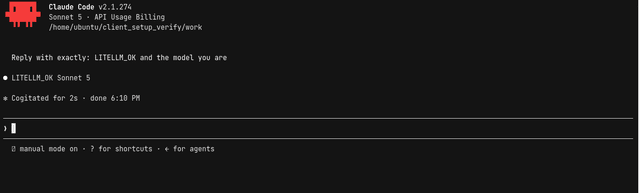
Then confirm the traffic in the Admin UI under Logs or Usage, attributed to your virtual key and the model you chose.
Sign in without a static key
Claude Code Gateway SSO is the native device sign-in option recommended for fleet rollout, with no per-user keys. You can also use lite auth print-token as apiKeyHelper after lite login --pkce, or use an IdP JWT helper
lite login --pkce --config-claude writes this login's key to ~/.claude/settings.json as env.ANTHROPIC_AUTH_TOKEN; rerun it after the key expires, or set apiKeyHelper so Claude Code fetches a fresh token itself
If a user's team or key restricts models, Claude Code's default model name must be on that list, or set ANTHROPIC_MODEL to an allowed alias. Otherwise requests fail with 403 The requested model '...' is not available for this API key
MCP setup
Expose your LiteLLM MCP gateway tools inside Claude Code with claude mcp add. The URL is <LITELLM_PROXY_BASE_URL>/<server_name>/mcp, where <server_name> matches a key under mcp_servers: in your gateway config, and the virtual key goes in the x-litellm-api-key header:
claude mcp add --transport http litellm-tools \
  http://localhost:4000/my_mcp_server/mcp \
  --header "x-litellm-api-key: Bearer $LITELLM_API_KEY"
| Part | Meaning |
|---|---|
litellm-tools | The name for this server inside Claude Code; choose anything |
http://localhost:4000/my_mcp_server/mcp | <PROXY_URL>/<server_name>/mcp; my_mcp_server must match the key under mcp_servers: on the gateway |
--header "x-litellm-api-key: Bearer $LITELLM_API_KEY" | Your virtual key, authenticating you to the gateway |
The key needs access to my_mcp_server (see the overview); otherwise the gateway rejects the connection with The key is not allowed to access the requested MCP servers. Start Claude Code and run /mcp: the server shows as connected with its tools listed, prefixed with the server name (my_mcp_server-read_wiki_structure).
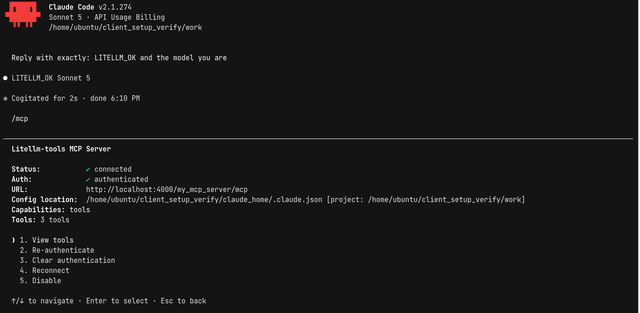
For servers behind upstream OAuth (for example a hosted GitHub or Atlassian MCP), keep the LiteLLM key in x-litellm-api-key and let LiteLLM run the OAuth flow; see MCP OAuth.
Next steps
Cut Claude Code costs with budgets, prompt caching, and fallbacks, bring your own Anthropic key, route Claude Code to non-Anthropic models, or check the Claude Code compatibility matrix.