Reliability test Multiple LLM Providers with LiteLLM
- Quality Testing
- Load Testing
- Duration Testing
uv add litellm python-dotenv
import litellm
from litellm.utils import load_test_model
import time
from dotenv import load_dotenv
load_dotenv()
Quality Test endpoint
Test the same prompt across multiple LLM providers
In this example, let's ask some questions about Paul Graham
models = ["gpt-6-luna", "gpt-6.1-sol", "claude-sonnet-5", "replicate/llama-2-70b-chat:58d078176e02c219e11eb4da5a02a7830a283b14cf8f94537af893ccff5ee781"]
context = """Paul Graham (/ɡræm/; born 1964)[3] is an English computer scientist, essayist, entrepreneur, venture capitalist, and author. He is best known for his work on the programming language Lisp, his former startup Viaweb (later renamed Yahoo! Store), cofounding the influential startup accelerator and seed capital firm Y Combinator, his essays, and Hacker News. He is the author of several computer programming books, including: On Lisp,[4] ANSI Common Lisp,[5] and Hackers & Painters.[6] Technology journalist Steven Levy has described Graham as a "hacker philosopher".[7] Graham was born in England, where he and his family maintain permanent residence. However he is also a citizen of the United States, where he was educated, lived, and worked until 2016."""
prompts = ["Who is Paul Graham?", "What is Paul Graham known for?" , "Is paul graham a writer?" , "Where does Paul Graham live?", "What has Paul Graham done?"]
messages =  [[{"role": "user", "content": context + "\n" + prompt}] for prompt in prompts] # pass in a list of messages we want to test
result = [litellm.batch_completion_models_all_responses(models=models, messages=message) for message in messages]
batch_completion_models_all_responses sends one conversation to every model in parallel and returns the responses that succeeded, so loop over the prompts. Models that raise are dropped from the returned list rather than surfaced as errors
Load Test endpoint
Run 100+ simultaneous queries across multiple providers to see when they fail + impact on latency. load_test_model takes a single model, so call it once per provider.
models=["gpt-6-luna", "replicate/llama-2-70b-chat:58d078176e02c219e11eb4da5a02a7830a283b14cf8f94537af893ccff5ee781", "claude-sonnet-5"]
context = """Paul Graham (/ɡræm/; born 1964)[3] is an English computer scientist, essayist, entrepreneur, venture capitalist, and author. He is best known for his work on the programming language Lisp, his former startup Viaweb (later renamed Yahoo! Store), cofounding the influential startup accelerator and seed capital firm Y Combinator, his essays, and Hacker News. He is the author of several computer programming books, including: On Lisp,[4] ANSI Common Lisp,[5] and Hackers & Painters.[6] Technology journalist Steven Levy has described Graham as a "hacker philosopher".[7] Graham was born in England, where he and his family maintain permanent residence. However he is also a citizen of the United States, where he was educated, lived, and worked until 2016."""
prompt = "Where does Paul Graham live?"
final_prompt = context + prompt
num_calls = 5
result = {model: load_test_model(model=model, prompt=final_prompt, num_calls=num_calls) for model in models}
load_test_model sends num_calls requests concurrently, but the calls_made field it returns is always 100 whatever num_calls is, so divide by your own num_calls when averaging
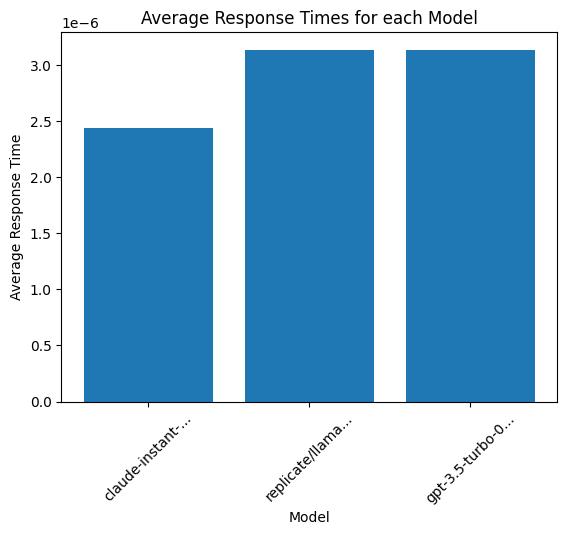
Visualize the data
import matplotlib.pyplot as plt

## calculate avg response time
avg_response_time = {}
for model, load_result in result.items():
    avg_response_time[model] = load_result["total_response_time"] / num_calls

models = list(avg_response_time.keys())
response_times = list(avg_response_time.values())

plt.bar(models, response_times)
plt.xlabel('Model', fontsize=10)
plt.ylabel('Average Response Time')
plt.title('Average Response Times for each Model')

plt.xticks(models, [model[:15]+'...' if len(model) > 15 else model for model in models], rotation=45)
plt.show()
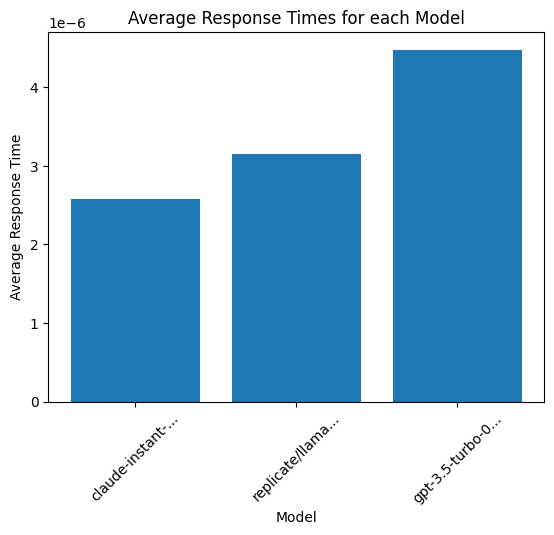
Duration Test endpoint
Run load testing for 2 mins. Hitting endpoints with 100+ queries every 15 seconds. load_test_model has no interval or duration options, so loop over it yourself.
models=["gpt-6-luna", "replicate/llama-2-70b-chat:58d078176e02c219e11eb4da5a02a7830a283b14cf8f94537af893ccff5ee781", "claude-sonnet-5"]
context = """Paul Graham (/ɡræm/; born 1964)[3] is an English computer scientist, essayist, entrepreneur, venture capitalist, and author. He is best known for his work on the programming language Lisp, his former startup Viaweb (later renamed Yahoo! Store), cofounding the influential startup accelerator and seed capital firm Y Combinator, his essays, and Hacker News. He is the author of several computer programming books, including: On Lisp,[4] ANSI Common Lisp,[5] and Hackers & Painters.[6] Technology journalist Steven Levy has described Graham as a "hacker philosopher".[7] Graham was born in England, where he and his family maintain permanent residence. However he is also a citizen of the United States, where he was educated, lived, and worked until 2016."""
prompt = "Where does Paul Graham live?"
final_prompt = context + prompt
interval = 15
duration = 120
result = []
num_calls = 100
end_time = time.time() + duration
while time.time() < end_time:
    result.append({model: load_test_model(model=model, prompt=final_prompt, num_calls=num_calls) for model in models})
    time.sleep(interval)
import matplotlib.pyplot as plt

## calculate avg response time
model_dict = {model: {"response_time": []} for model in models}
for iteration in result:
  for model, load_result in iteration.items():
    model_dict[model]["response_time"].append(load_result["total_response_time"] / num_calls)

avg_response_time = {}
for model, data in model_dict.items():
    avg_response_time[model] = sum(data["response_time"]) / len(data["response_time"])

models = list(avg_response_time.keys())
response_times = list(avg_response_time.values())

plt.bar(models, response_times)
plt.xlabel('Model', fontsize=10)
plt.ylabel('Average Response Time')
plt.title('Average Response Times for each Model')

plt.xticks(models, [model[:15]+'...' if len(model) > 15 else model for model in models], rotation=45)
plt.show()