
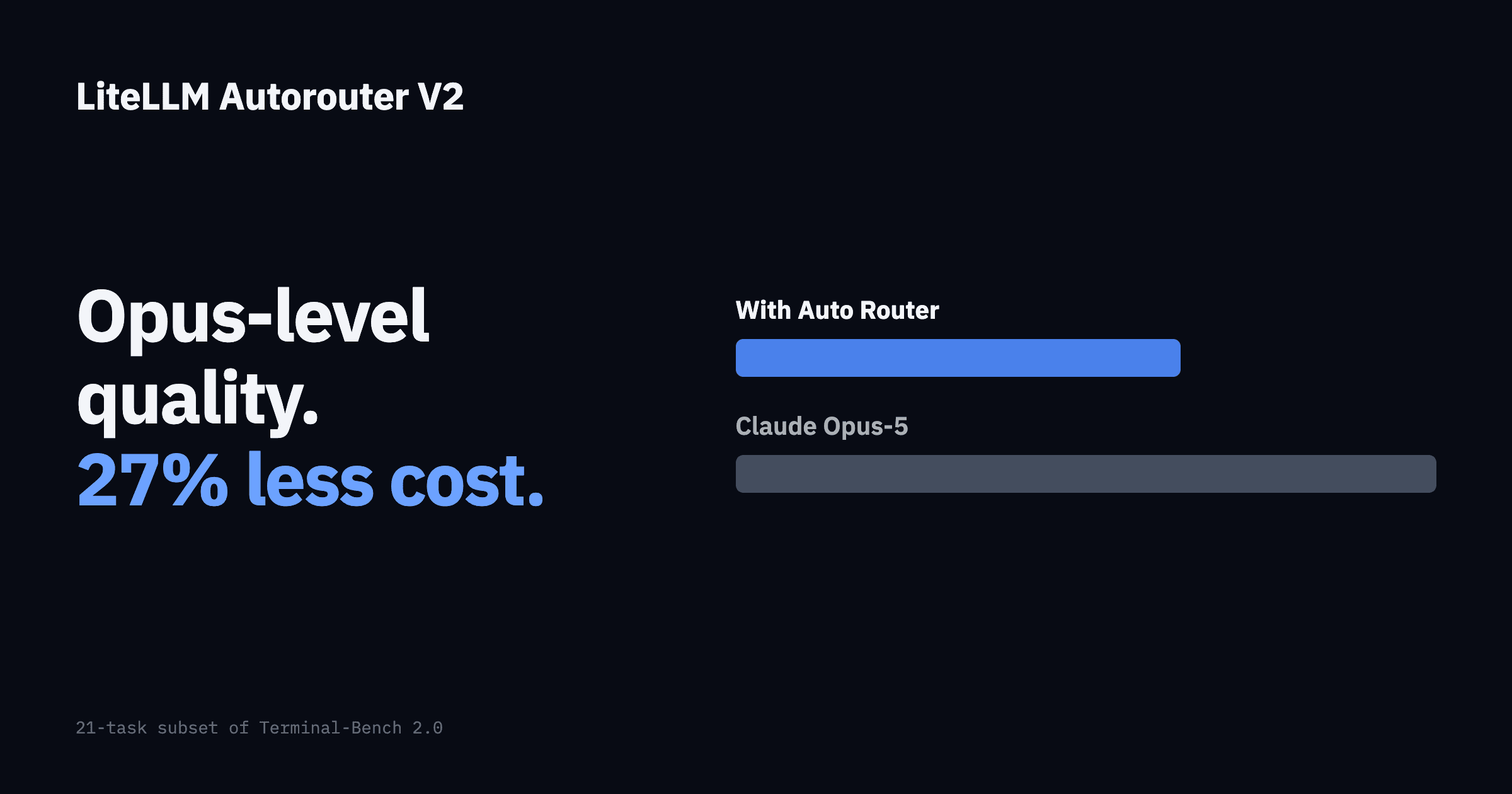
An auto router matched Claude Opus-5 solve rate on a 21 task subset of Terminal-Bench 2.0 at 27% lower cost. Every arm ran the same 21 tasks, so the comparisons are like for like.
Get early access, work directly with the LiteLLM team, and influence the roadmap with your production traffic.
Apply to Become a Design PartnerAlready testing it? Share your results in discussion #32168.
Key findings
- Opus level quality at 27% lower cost. The 5.4-mini classifier (single message context) router solved 16/21 tasks, the same as Opus-5, for $14.34 against $19.74
- Instead of increasing context-window, consider a better model Going from 1-message context to the last 3 user messages took the 4o-mini router from 66.7% to 76.2%, and cost from $12.86 to $18.58: +14% relative quality, +44% cost. GPT 5.4-mini classifier with 1-message context beats these results at lower cost.
- Context slows tasks down. Median wall clock per task went from 6.8 min to 8.3 min when adding 3-6 messages as context
- Adding assistant replies isn't worth it. A window of 6 messages including LLM replies dropped relative quality 7% (66.7% to 61.9%) and raised cost 34%
- The heuristic router is a good value option. 87% of Opus quality at 56% of the cost, with no classifier call and the lowest median wall clock of any arm
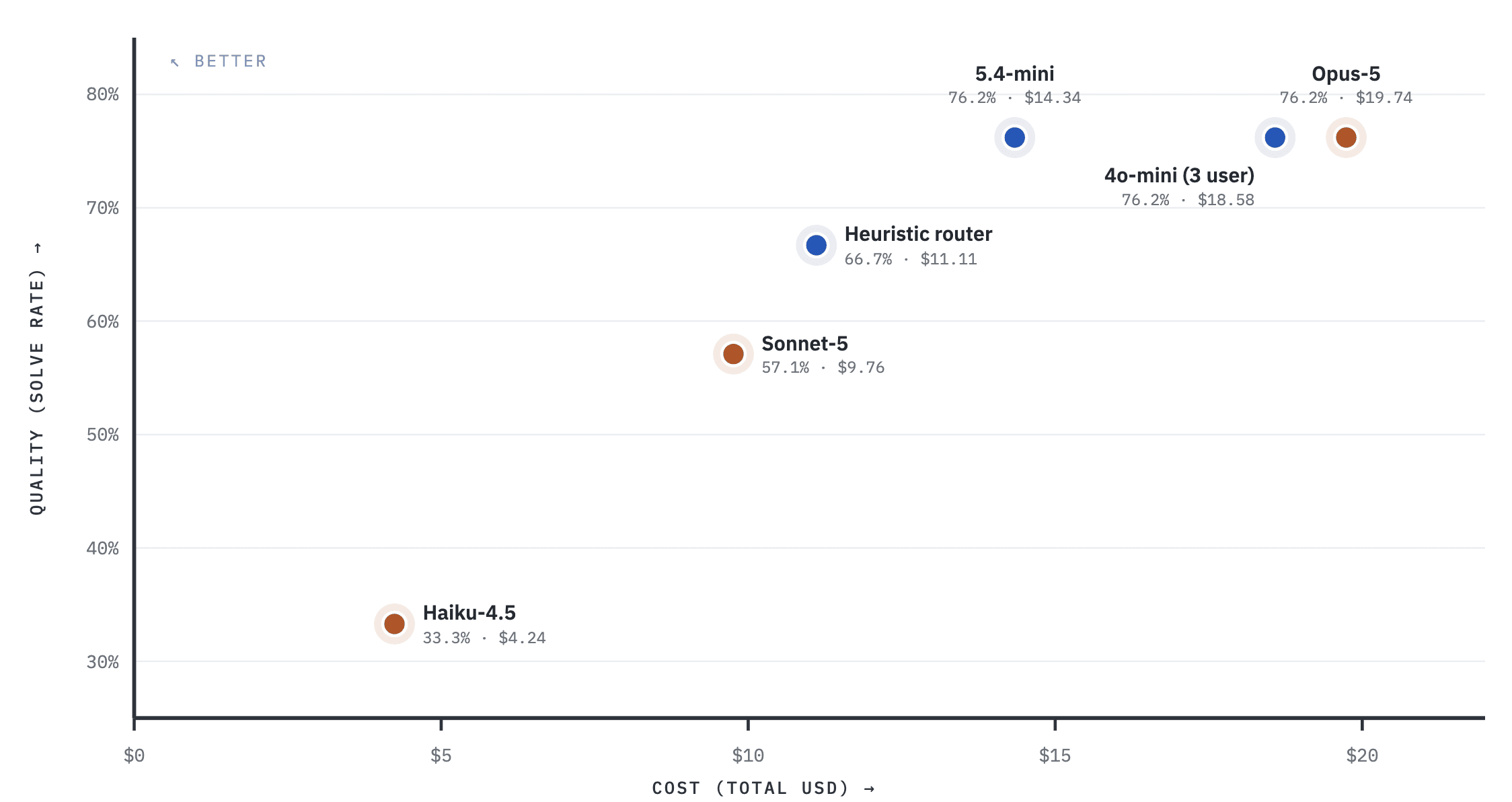
Results
| Configuration | Solve rate | Solved/n | Total cost | $/solved | Median task wall clock | p95 turn | Haiku/Sonnet/Opus | Switch rate | Cache hit |
|---|---|---|---|---|---|---|---|---|---|
| Router: 5.4-mini | 76.2% | 16/21 | $14.34 | $0.90 | 6.7 min | 62.8s | 20%/39%/40% | 54% | 78% |
| Router: 4o-mini (3 user) | 76.2% | 16/21 | $18.58 | $1.16 | 8.3 min | 67.9s | 18%/36%/45% | 55% | 78% |
| Opus-5 only | 76.2% | 16/21 | $19.74 | $1.23 | 6.4 min | 94.6s | 0%/0%/99% | 4% | 89% |
| Router: heuristic | 66.7% | 14/21 | $11.11 | $0.79 | 5.6 min | 43.3s | 32%/53%/14% | 48% | 83% |
| Router: 4o-mini (1-message) | 66.7% | 14/21 | $12.86 | $0.92 | 6.8 min | 53.1s | 33%/34%/34% | 58% | 79% |
| Router: 4o-mini (6 both) | 61.9% | 13/21 | $17.23 | $1.33 | 6.3 min | 112.3s | 5%/50%/44% | 46% | 80% |
| Sonnet-5 only | 57.1% | 12/21 | $9.76 | $0.81 | 8.5 min | 60.5s | 0%/99%/0% | 1% | 93% |
| Haiku-4.5 only | 33.3% | 7/21 | $4.24 | $0.61 | 4.9 min | 12.6s | 100%/0%/0% | 0% | 93% |
Cost is the total for all 21 tasks and includes the classifier call, which ran between $0.05 and $0.34 depending on the classifier.
Breakdown of Context Window Results
1-message sends only the current user message to the classifier. 3 user sends the last 3 user messages. 6 both sends the last 6 messages including assistant replies. All three use the same 4o-mini classifier and the same tier mapping, so the only variable is what the classifier reads. 5.4-mini with no context beat all, overall.
| Context window | Solve rate | Relative to 1-message | Total cost | Relative to 1-message | Median task wall clock |
|---|---|---|---|---|---|
| 1-message | 66.7% | reference | $12.86 | reference | 6.8 min |
| Last 3 user messages | 76.2% | +14% | $18.58 | +44% | 8.3 min |
| Last 6 messages, user and assistant | 61.9% | -7% | $17.23 | +34% | 6.3 min |
Prior user turns tell the classifier what the task actually is, so it escalates to Opus on the turns that need it: the Opus share goes from 34% to 45%, which is where most of the extra cost comes from. Assistant replies pull in tool output and long generated text that read as complexity signal without adding task intent; that arm routed almost nothing to Haiku (5%) yet still scored worst of the three.
How it was measured
- Benchmark: a 21 task subset of Terminal-Bench 2.0, completed by all 8 arms: adaptive-rejection-sampler, build-pmars, chess-best-move, cobol-modernization, crack-7z-hash, filter-js-from-html, gcode-to-text, install-windows-3.11, largest-eigenval, llm-inference-batching-scheduler, merge-diff-arc-agi-task, multi-source-data-merger, overfull-hbox, password-recovery, polyglot-c-py, prove-plus-comm, pypi-server, sparql-university, train-fasttext, winning-avg-corewars, write-compressor
- Router arms: one model group, four tiers. SIMPLE to
claude-haiku-4-5, MEDIUM toclaude-sonnet-5, COMPLEX and REASONING toclaude-opus-5. Classifier is either the heuristic or an LLM (gpt-4o-mini,gpt-5.4-mini) - Baseline arms: every request to one fixed model, with prompt caching on in all arms
- Cost: total USD across all 21 tasks from gateway spend logs, classifier calls included
- Errors: 0 to 4 per arm, from harness and provider failures, excluded from solve rate denominators only where the task did not complete for that arm
Config
model_list:
  - model_name: claude-haiku-4-5
    litellm_params:
      model: anthropic/claude-haiku-4-5
      api_key: os.environ/ANTHROPIC_API_KEY
  - model_name: claude-sonnet-5
    litellm_params:
      model: anthropic/claude-sonnet-5
      api_key: os.environ/ANTHROPIC_API_KEY
  - model_name: claude-opus-5
    litellm_params:
      model: anthropic/claude-opus-5
      api_key: os.environ/ANTHROPIC_API_KEY

  - model_name: smart-router
    litellm_params:
      model: auto_router/complexity_router
      complexity_router_config:
        tiers:
          SIMPLE:    claude-haiku-4-5
          MEDIUM:    claude-sonnet-5
          COMPLEX:   claude-opus-5
          REASONING: claude-opus-5
        classifier_type: llm
        classifier_llm_config:
          model: gpt-5.4-mini
        classifier_context_window_size: 0
      complexity_router_default_model: claude-sonnet-5
Every response carries x-litellm-model-name and x-litellm-response-cost, and per router cost and usage land in the Auto-Router Benchmarks tab. Full reference on the Auto Routing docs page.
Try it
Point an agent at an auto router and compare it against your current single model on your own workload. Share numbers or questions in discussion #32168. To work on this with us directly, apply to be a design partner.