October Townhall Updates: 426 Bug Fixes, 88.4% Coverage, and the Decisions API

Thank you to everyone who joined our October town hall. We covered security, stability and performance work, and the product updates from the month.
Security
On October 21 our release pipeline published a compromised litellm==1.107.0. The attack chain post has the full record and what to do.
We shipped 65 security fixes in stable releases between September 24 and October 12, broken down by category:
| Category | Fixes |
|---|---|
| Credential / secret / PII | 18 |
| General hardening | 18 |
| Quota / budget / rate limits | 15 |
| Access control / authz | 14 |
Three changes need action before you upgrade.
| Change | Version |
|---|---|
| The proxy does not start without a strong master key | v1.104.0 |
STDIO MCP servers are off. LITELLM_ENABLE_MCP_STDIO=true turns them on | v1.104.0 |
/sso/debug is off. ENABLE_SSO_DEBUG=true turns it on | v1.105.0 |
- We are doubling the security team with a second dedicated headcount.
- The focus moves from reactive to proactive.
- We are formalising how we handle vulnerabilities, disclosures and customer security requests.
Stability
In October we shipped 426 bug fixes.
| Area | Fixes |
|---|---|
| Providers | 120 |
| Spend, budgets, observability | 94 |
| Proxy core | 82 |
| Streaming / realtime | 40 |
| UI, auth, SSO | 40 |
| MCP gateway | 27 |
| Other / SDK | 23 |
Providers took the largest share, which is where a model release or an API change shows up first.
- Coverage. 83.5% in September, 88.4% today.
- User journeys. Up from 521 to 7,048 covered, against a 600 target for October.
- Every release now runs 7,048 integration tests, 877 end to end tests and 3 performance benchmarks.
- Roadmap. Tracked in issue #30484.
Where the gateway got faster
| Metric | Before | After |
|---|---|---|
| Time to first byte on 440K-token prompts | 553 ms | 35 ms |
| Redis round trips per request | 22 | 8 |
| Usage page load with 5,000+ keys | 6+ min | 3.2 s |
The litellm-core install is also 65.6 MB smaller.
Rust path
OCR runs on Rust by default, and /v1/messages is opt-in behind a flag.
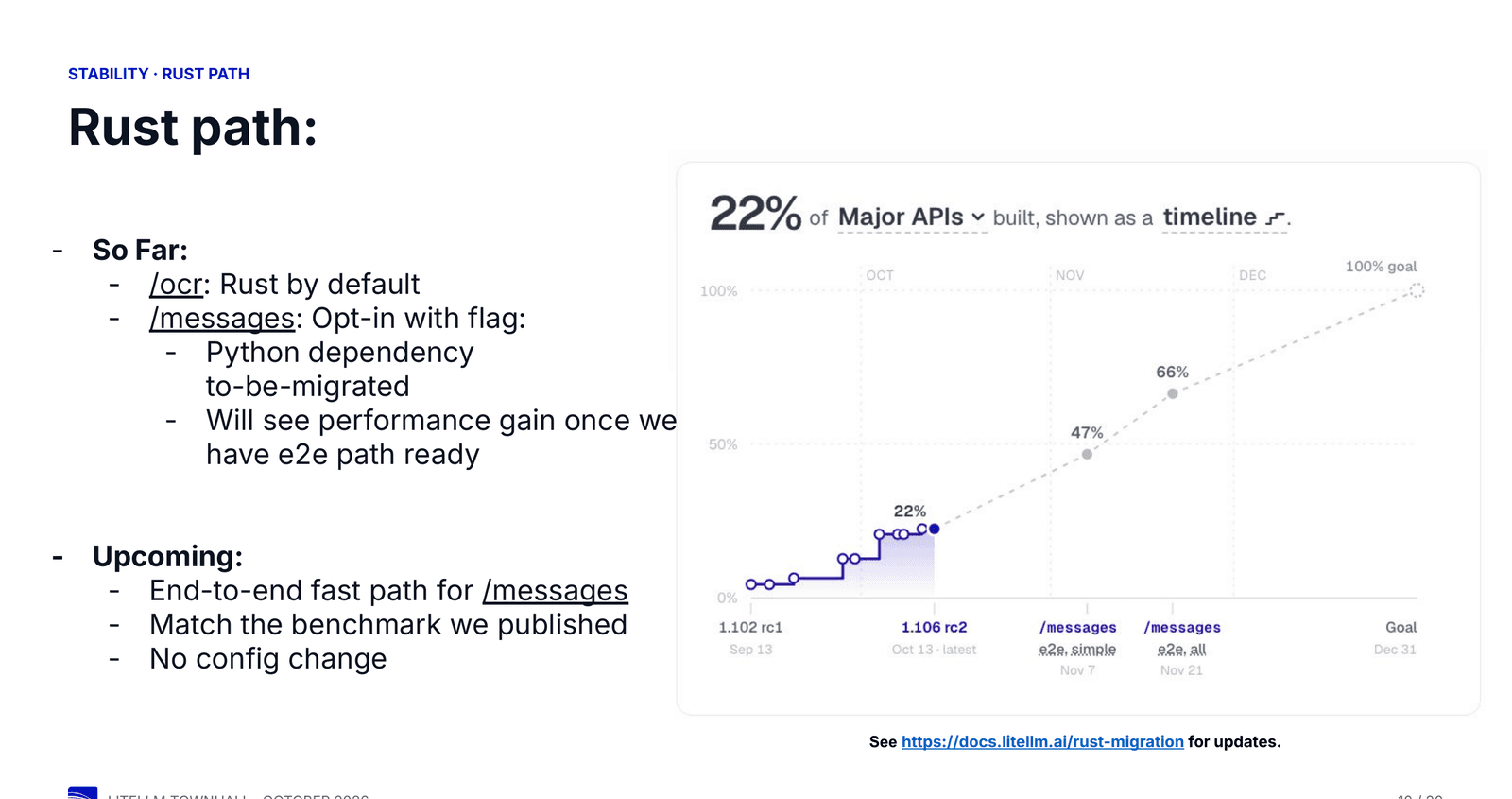
/v1/messagesstill has a Python dependency to migrate, so the speed arrives with the end to end path.- Progress is public at docs.litellm.ai/rust-migration, currently at 22%.
Product
Decisions API
/v1/decisions asks a yes/no, multiple-choice or score question about an input and returns a probability for each answer.
- Keys, budgets, spend, fallbacks and guardrails all apply.
- Providers: OpenAI, Perplexity, TypeSafe Jev, OpenRouter, Cloudflare, vLLM, Azure AI, Strands Decider, Databricks, Fireworks AI, Laya, Bespoke and Nace.
- JevRank puts those models behind the rerank API, so you swap a rerank call without a change to your application. The JevRank post has the SciFact results.
- See the decisions docs for setup.
Auto Router
- Use any decision model as the classifier.
- Self-hosted OSS classifiers, Laya and Bespoke Nimble, arrive next release.
- Context compaction is on by default. Prompt-cache cost routing is opt-in.
- Tokens, cost and savings per router land next release.
Lens
Lens uses AI agents to read your agent traces and find recurring failures. Teams run hundreds of agents and 200K or more traces, which nobody reads by hand.
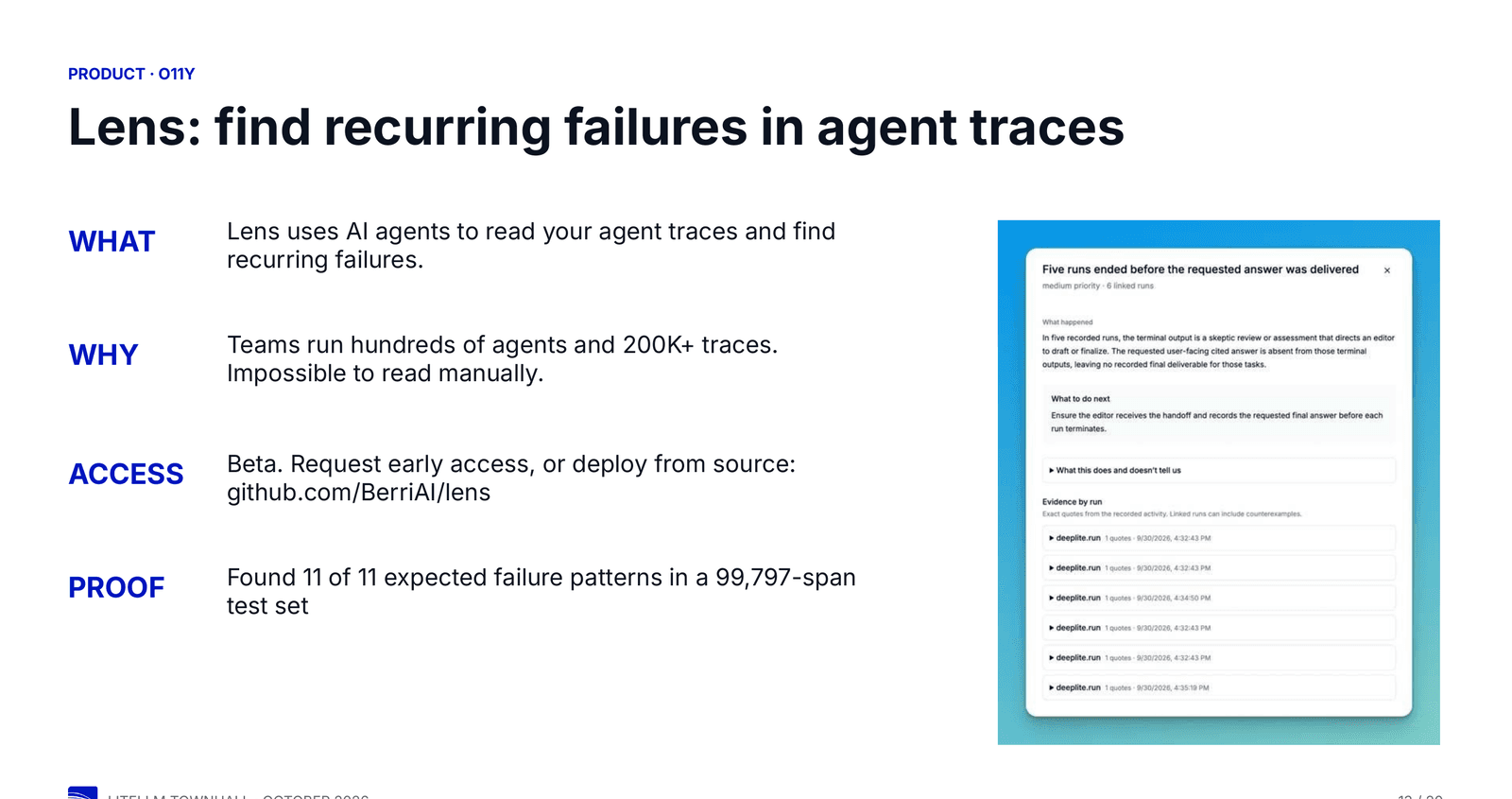
- It found 11 of the 11 expected failure patterns in a 99,797-span test set.
- Beta. Request early access, or deploy from source at github.com/BerriAI/lens.
Moyai
Moyai is an open source coding agent that runs in your cloud. Give it a task from Slack or the browser, then review the pull request it opens.
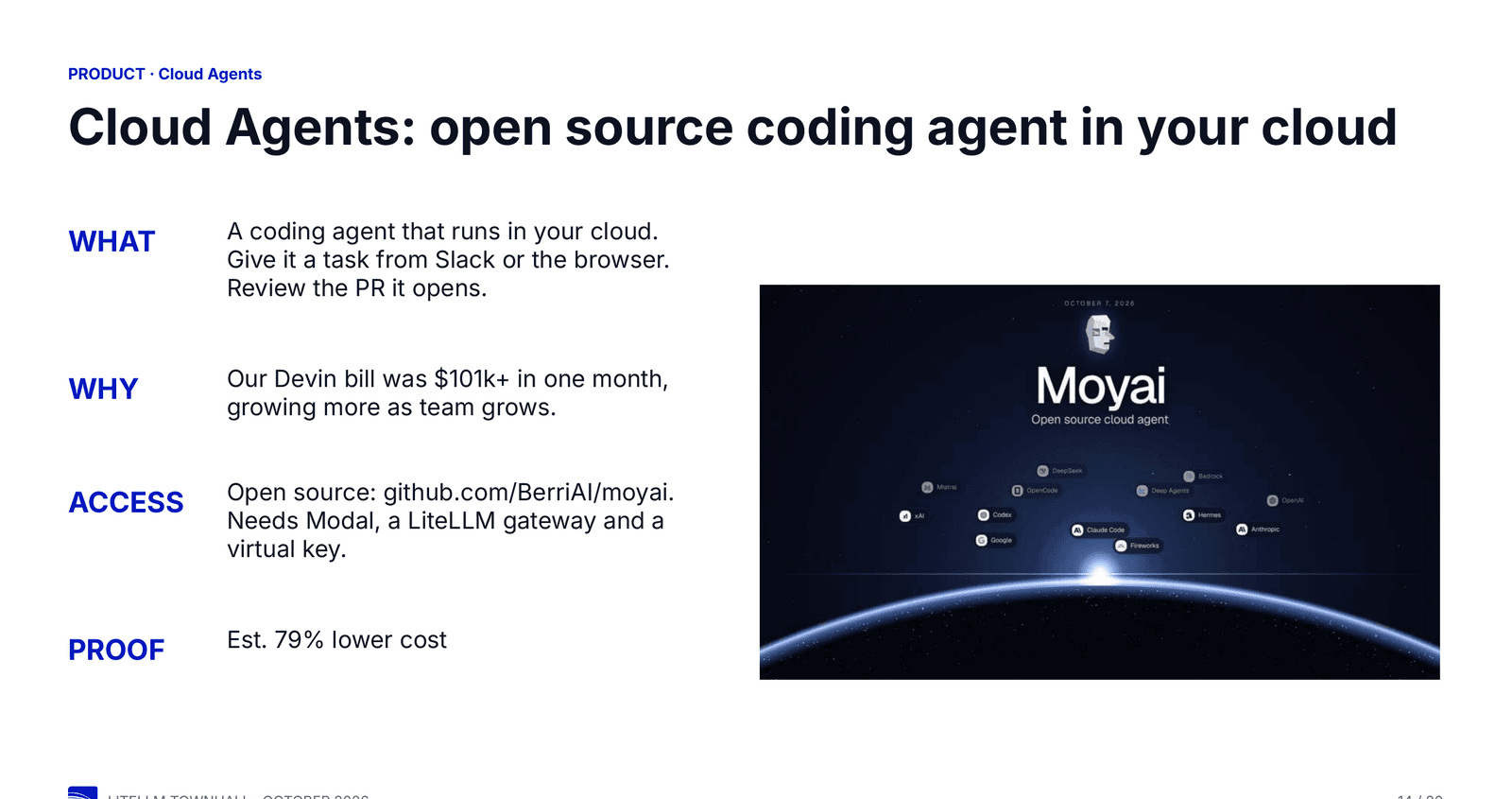
- Our own Devin bill passed $101k in one month, and it grew with the team.
- Moyai is an estimated 79% lower cost.
- It needs Modal, a LiteLLM gateway and a virtual key: github.com/BerriAI/moyai.
LiteLLM Relay
Relay connects to your existing Jamf, Intune or Kandji MDM and installs on every corporate Mac, then points Claude Code, Claude Desktop and Codex at LiteLLM.
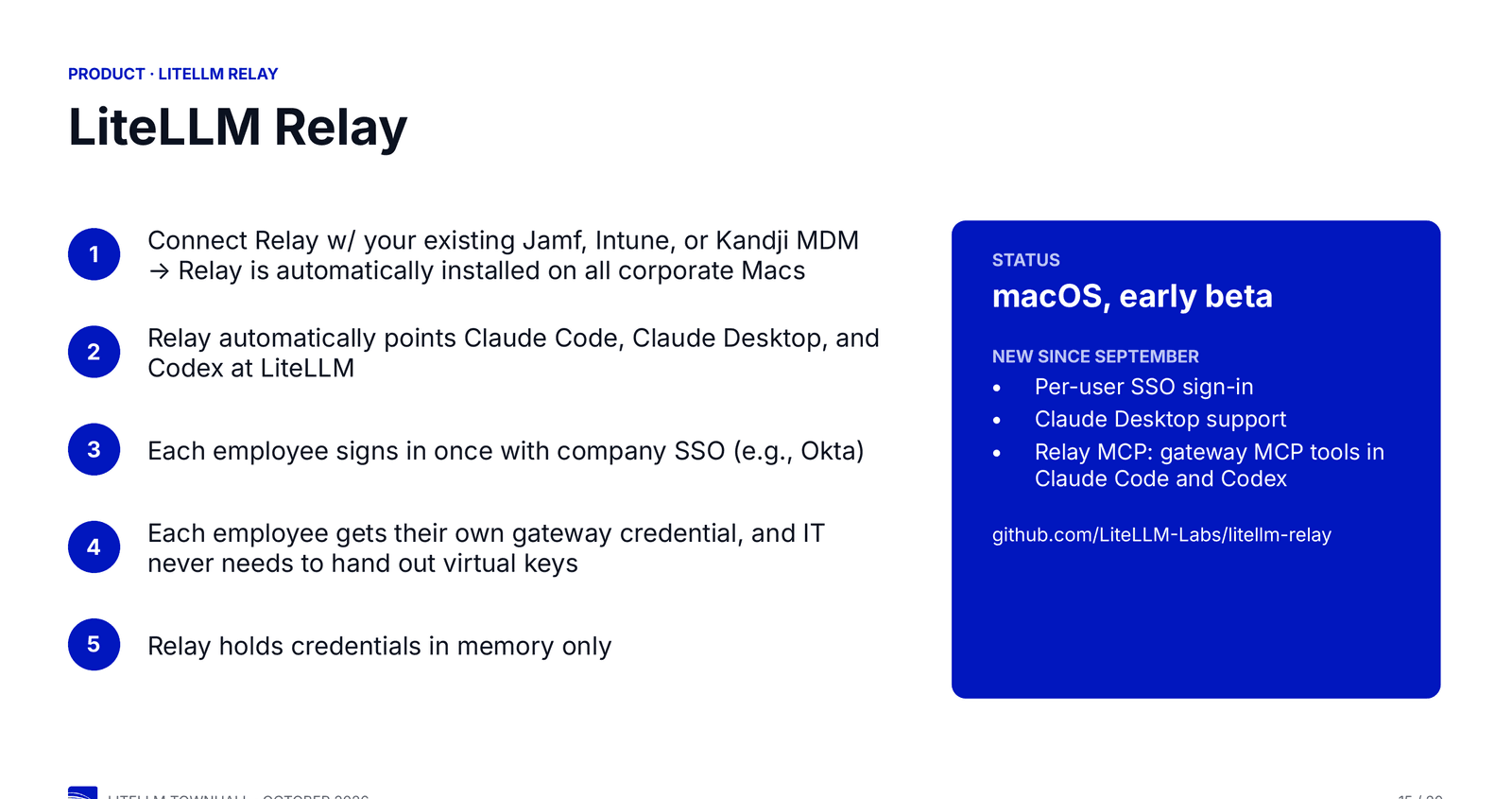
- Each employee signs in once with company SSO and gets their own gateway credential, so IT never hands out virtual keys.
- Relay holds credentials in memory only.
- New since September: per-user SSO sign-in, Claude Desktop support, and Relay MCP for gateway MCP tools in Claude Code and Codex.
- macOS early beta at github.com/LiteLLM-Labs/litellm-relay.
Claude Code and Codex through the gateway
- In Claude Code, run
/loginand pick "Cloud gateway". In Codex, sign in withlite codex. - Refresh tokens land next release and keep you signed in for 14 days. Before, users signed in every 24 hours.
Handoff, our cloud agent workshop
Handoff runs remote from October 26 to November 9. Sign up at handoff.litellm.ai.
Roadmap
- Now. Harden CI/CD and product security, complete the Rust migration by December 1, and reduce regressions.
- Next one to two months. Resolve more than a thousand open GitHub issues and improve the developer experience.
- Next three to six months. The core workflows for developers who build production agents on LiteLLM.
We're hiring
We have open roles across the core gateway, and two new security roles. Reach us at recruiting@berri.ai, or product@berri.ai for product feedback.
Thank you for using LiteLLM. The LiteLLM Team