LiteLLM AI Gateway
Customer Management
Budget and charge your agent's customers.
Illustrative customer traffic flows through LiteLLM into Customer Management. Organization, team, and member budgets use three views of the same request cost.




Today we're launching LiteLLM Customer Management for AI-native companies using the gateway. If you're building an agent on LiteLLM and need to track spend and set budget limits for your customers by their organizations, teams, and individual members, this is for you.
Who is this for?
For AI-native companies building production agents using LiteLLM AI Gateway who need to run their agents profitably, with positive ROI.
The problem
With B2B AI agents, cost tracking gets complicated across customer organizations, teams, and individual members. If you sell pay-as-you-go credits or usage-based plans, actual spend can exceed what your customer paid and hurt your margin.
Actual spend exceeds the credits your customer bought.
Different models, providers, and request parameters multiply that complexity.
Track that spend by customer organization, team, and member:
That's a bunch of glue code to build around your agent. Since LiteLLM is already your source of truth for model costs, we're exposing APIs to track customer spend, set budgets, and build these controls into your product.
How to use LiteLLM AI Gateway for this problem
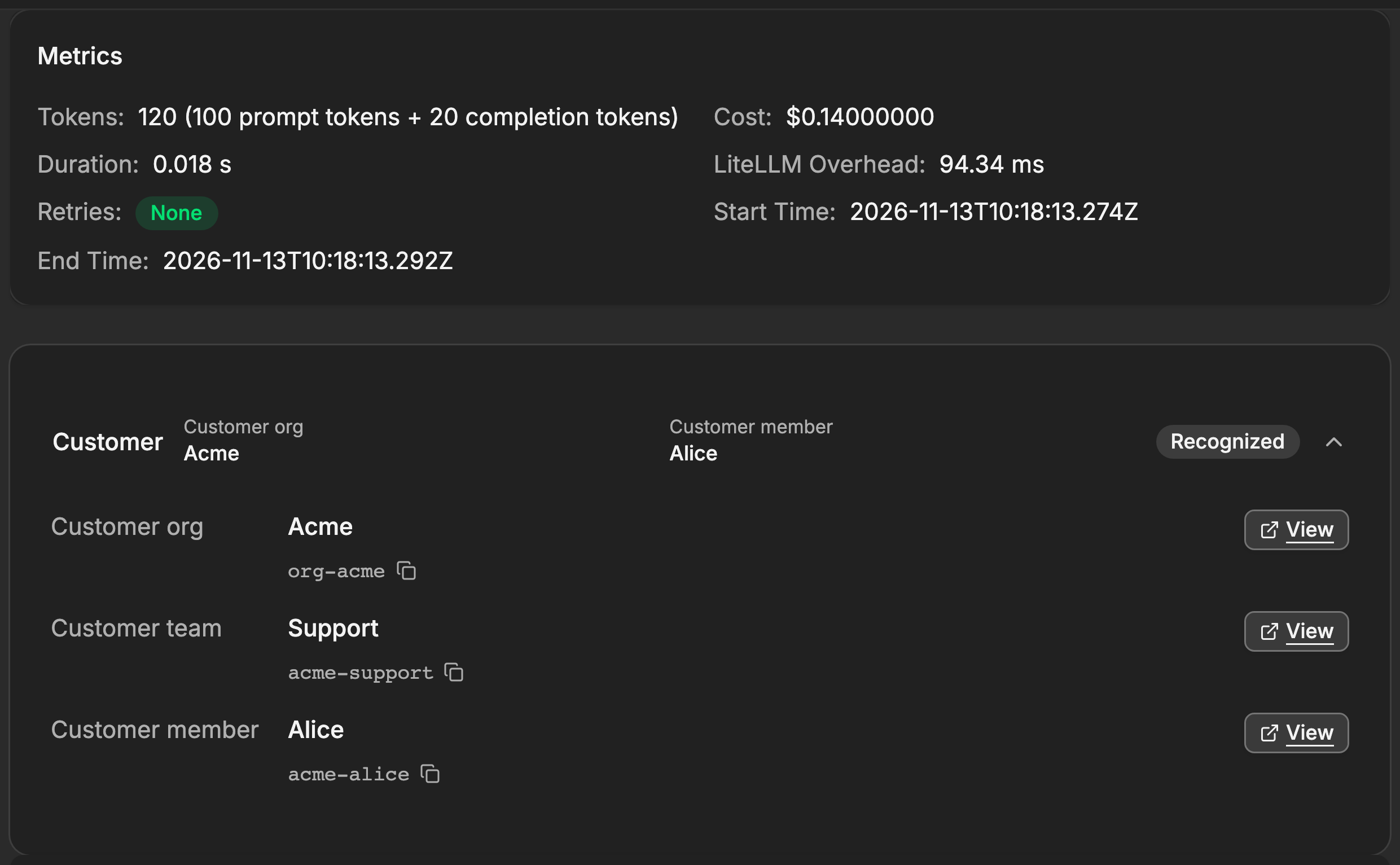
Point your agent to LiteLLM AI Gateway and send your customer's organization alias and member ID:
- OpenAI Responses
- LangChain Deep Agents
import os

from openai import OpenAI

client = OpenAI(
    api_key=os.environ["LITELLM_API_KEY"],
    base_url=f"{os.environ['LITELLM_BASE_URL'].rstrip('/')}/v1",
)
raw_response = client.responses.with_raw_response.create(
    model=os.environ["LITELLM_MODEL"],
    input="Write a short welcome message.",
    max_output_tokens=128,
    extra_headers={
        "x-litellm-customer-org-alias": "Acme",
        "x-litellm-customer-member-id": "acme-alice",
    },
)
response = raw_response.parse()
print(response.output_text)
print("LiteLLM call ID:", raw_response.headers.get("x-litellm-call-id"))
Install with pip install openai.
import os

from deepagents import create_deep_agent
from langchain_openai import ChatOpenAI

model = ChatOpenAI(
    model=os.environ["LITELLM_MODEL"],
    base_url=f"{os.environ['LITELLM_BASE_URL'].rstrip('/')}/v1",
    api_key=os.environ["LITELLM_API_KEY"],
    use_responses_api=True,
    default_headers={
        "x-litellm-customer-org-alias": "Acme",
        "x-litellm-customer-member-id": "acme-alice",
    },
)
agent = create_deep_agent(model=model)
result = agent.invoke({"messages": [{"role": "user", "content": "Say hello to Alice."}]})
print(result["messages"][-1].text)
Install with pip install deepagents langchain-openai. Configure the model for the authenticated customer; pass the same identity to any other models the agent calls.
That's it for attributing the call. LiteLLM resolves the member's customer team and organization and records the spend. The same headers work with Responses, Chat Completions, and Anthropic Messages.
Use your application key and a gateway model alias. LITELLM_BASE_URL is the gateway root URL; register the customer first, and select their identity from your authenticated session.
Set customer budgets that protect your margin
If a member buys $100 in credits, set a $60 budget for actual spend to protect your margin. Set separate budgets for the customer organization, each team, and each member:

organization
team
member
The same request's cost rolls up from the member to their team and organization. Here, the member hits their $60 cap while both parents still have room, so further requests pause.
Choose the organization cap and default member profile when you onboard a customer. These examples use a 30-day budget period:
- API
- LiteLLM UI
curl --fail-with-body --request POST \
  "$LITELLM_BASE_URL/management/v1/customer_organizations" \
  --header "Authorization: Bearer $LITELLM_ADMIN_KEY" \
  --header "Content-Type: application/json" \
  --data '{
    "customer_org_id": "org-acme",
    "alias": "Acme",
    "budget": {
      "max_budget": 1000,
      "budget_duration": "30d"
    },
    "default_budgets": [{
      "name": "default-user",
      "max_budget": 60,
      "soft_budget": 48,
      "budget_duration": "30d"
    }],
    "default_budget_template": "default-user"
  }'
Use a server-side proxy admin credential as LITELLM_ADMIN_KEY. Add the customer's teams and members; new members inherit the default profile.
Open Customer Management → Customers → your customer → Settings. Use Set budget or Edit budget to set Spend limit (USD) and Reset period. Select a member's Budget template for its default allowance.

At the cap, LiteLLM rejects new requests based on recorded spend. Leave room for accounting delays and requests already in flight.
Give default users and power users different profiles
Some customers need more allowance. Create a power-user profile, then assign its returned budget_id when you create new members. Use the same APIs in your product so your customer's admins can manage these profiles.
curl --fail-with-body --request POST \
  "$LITELLM_BASE_URL/management/v1/customer_organizations/org-acme/default_budgets" \
  --header "Authorization: Bearer $LITELLM_ADMIN_KEY" \
  --header "Content-Type: application/json" \
  --data '{
    "name": "power-user",
    "max_budget": 90,
    "soft_budget": 72,
    "budget_duration": "30d"
  }'
Trigger a webhook when a customer hits their limit
When a member reaches their $60 cap, use the budget webhook to alert your team or open an approval request. Your receiver formats the notification from LiteLLM's JSON event. Configure and test delivery; reconcile missed alerts with usage reads because delivery is best effort.
Approve a temporary increase when your customer upgrades
When the customer buys another $50 in credits, their total becomes $150. After approval, apply a temporary $90 cap on actual spend, as shown above.
Set INCREASE_EXPIRES_AT to a future timestamp with a timezone, then apply the temporary member override:
curl --fail-with-body --request PATCH \
  "$LITELLM_BASE_URL/management/v1/customer_members/acme-alice" \
  --header "Authorization: Bearer $LITELLM_ADMIN_KEY" \
  --header "Content-Type: application/json" \
  --data "{
    \"budget_override\": {\"max_budget\": 90},
    \"budget_override_expires_at\": \"$INCREASE_EXPIRES_AT\"
  }"
Your product manages credit purchases and balances. LiteLLM applies the spend allowance until it expires; the organization and team caps still apply. Use the approval APIs if your workflow needs a review queue.
Put the usage and budget controls in your own product
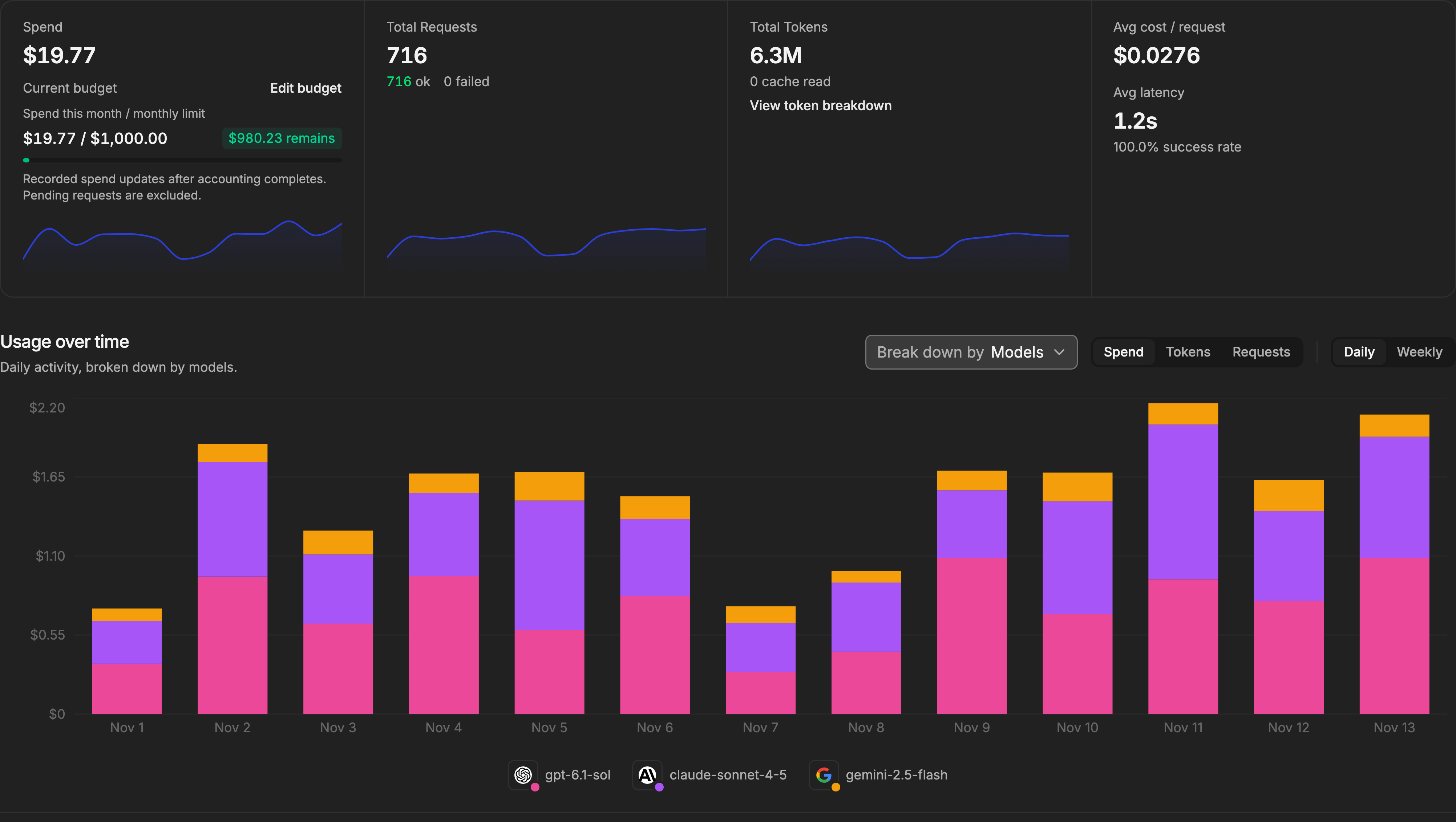
Put usage next to the customer's credits and top-up options. Our APIs let your backend fetch actual spend and budget settings, so the customer sees the same costs you use for chargebacks:
Fetch complete organization totals for a date range:
curl --fail-with-body --silent --show-error --get \
  "$LITELLM_BASE_URL/management/v1/customer_organizations/daily/activity/aggregated" \
  --header "Authorization: Bearer $LITELLM_ADMIN_KEY" \
  --data-urlencode "customer_org_ids=org-acme" \
  --data-urlencode "start_date=2026-11-01" \
  --data-urlencode "end_date=2026-11-30"
Read metadata.total_spend, total_tokens, and total_api_requests. Fetch caps from the organization, team, and member records; keep admin credentials on your backend and authorize each customer's access. Your billing system applies your prices and collects payment.
Keep serving requests with a lower-cost model
Give a customer's dedicated virtual key an Opus allowance, then configure a lower-cost fallback for when that model allowance runs out. The customer can keep using your agent while they still have room in their overall budget.
 Opus 5.5Allowance reachedRoutes the next request
 GPT-6 LunaServing requests
Opus: $40 / $40 allowance
Fallback: $10 spend
50% profit margin$10 left in customer budgetSet model_max_budget and budget_fallbacks on the key with your configured model aliases. These per-model key budgets require Enterprise. A shared key pools its model budget across callers; customer organization, team, and member hard caps still stop requests when exhausted. See Budget Fallbacks for the API setup.
OSS and Enterprise
| Customer Management | LiteLLM OSS | LiteLLM Enterprise |
|---|---|---|
| Customer organizations | Up to 5 | More than 5 |
| Customer teams per organization | Up to 5 | More than 5 |
| Customer members per team | Up to 5 | More than 5 |
Start with the walkthrough and API reference. For larger customer hierarchies, talk to us about Enterprise.
This draft targets main; a published release containing the complete flow has not been verified. Check availability before deploying.