Azure PTU Flat Cost Attribution
Azure provisioned throughput is billed by the hour for reserved capacity, not per token. A team with its own PTU deployment pays that hourly rate whether it sends one request or a million, so LiteLLM's per-token cost tracking reports nothing that matches the invoice. PTU flat cost attribution fixes the mismatch: you tell LiteLLM how much capacity a deployment reserves and what it costs per hour, and a daily job attributes that cost to the owning team.
A PTU deployment is billed by its reserved capacity alone. LiteLLM stores zero per-token pricing on it, so the traffic the capacity serves is never charged on top of the flat cost.
One deployment can also be split across several teams in PTUs. Each team's share becomes a per-minute ceiling the proxy enforces, the flat cost is attributed by share, and usage reports the PTU-hours each team consumed next to its tokens. See Share a deployment across teams
Enable it
The feature is off by default and inert until you opt in:
export LITELLM_ENABLE_PTU_COST_ATTRIBUTION=True
A configured secret manager can hold the variable instead. When the proxy would ask a secret manager for it, as it does for other settings, the secret manager's value wins over the environment and is read at most once a minute. The environment decides only when no secret manager is consulted.
With the variable unset the daily job is not scheduled, the model endpoints reject PTU configuration, the usage read path reports zero flat cost, and the PTU inputs stay hidden in the model form.
Configure a deployment
PTU configuration lives on the deployment's model_info. In the Admin UI, open Models + Endpoints, pick the deployment, and edit its settings. The PTU inputs sit directly under the per-token costs, which LiteLLM holds at zero for you:
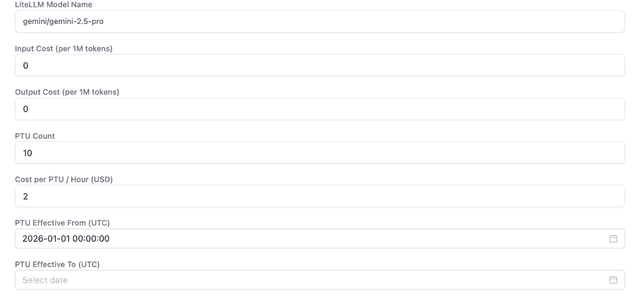
The same thing through POST /model/new:
curl -X POST http://localhost:4000/model/new \
  -H "Authorization: Bearer $LITELLM_MASTER_KEY" \
  -H 'Content-Type: application/json' \
  -d '{
    "model_name": "gpt-4o-ptu",
    "litellm_params": {
      "model": "azure/<your-deployment-name>",
      "api_key": "os.environ/AZURE_API_KEY",
      "api_base": "os.environ/AZURE_API_BASE"
    },
    "model_info": {
      "team_id": "<the owning team id>",
      "ptu_count": 100,
      "cost_per_ptu_per_hour": 0.02,
      "ptu_effective_from": "2026-01-01T00:00:00Z"
    }
  }'
Or in config.yaml:
model_list:
  - model_name: gpt-4o-ptu
    litellm_params:
      model: azure/<your-deployment-name>
      api_key: os.environ/AZURE_API_KEY
      api_base: os.environ/AZURE_API_BASE
    model_info:
      id: gpt-4o-ptu-team-a
      team_id: <the owning team id>
      ptu_count: 100
      cost_per_ptu_per_hour: 0.02
      ptu_effective_from: "2026-01-01T00:00:00Z"
model_info.id is required on a deployment declared this way, and the proxy refuses to load one without it, naming the deployment in the startup log. Left to itself the id is derived from the model name and the resolved litellm_params, so rotating the credential mints a new identity and the reservation is charged a second time under it, which nothing later retracts. Any stable string works, and it has to be unique across your deployments
Upgrading an existing reservation that has already accrued cost, set id to the id it uses today rather than a fresh name, or the charges already written stay under the old identity and the new one starts beside them. The startup refusal quotes that current id so you can copy it
team_id is what the capacity is billed to, so a declaration without one accrues nothing
| Field | Required | Meaning |
|---|---|---|
id | in config.yaml | The deployment's stable identity. Not needed through the API or the UI, where one is stored for you |
team_id | one of the two | The team the capacity belongs to, when one team owns the whole deployment |
ptu_shares | one of the two | Team id to whole PTUs, adding up to ptu_count, when several teams share it |
ptu_count | yes | Provisioned throughput units reserved, a whole number |
cost_per_ptu_per_hour | yes | Your contracted hourly rate per unit |
ptu_effective_from | yes | When the reservation starts accruing |
ptu_effective_to | no | When it stops. Leave unset for an open reservation |
base_model | for the ceiling | The Azure model name when the deployment name is not one, e.g. gpt-4.1 |
ptu_count and cost_per_ptu_per_hour must be set together, and ptu_effective_from is required because flat cost accrues from that instant. Without it a deployment configured today would bill for days it did not exist.
Take cost_per_ptu_per_hour from your Azure agreement rather than a list price; PTU rates are negotiated and vary by region and commitment term.
Share a deployment across teams
A department that reserves 50 PTUs and lets two teams use them declares the split once, in PTUs, with model_info.ptu_shares in place of team_id:
curl -X POST http://localhost:4000/model/new \
  -H "Authorization: Bearer $LITELLM_MASTER_KEY" \
  -H 'Content-Type: application/json' \
  -d '{
    "model_name": "gpt-4.1-ptu",
    "litellm_params": {
      "model": "azure/<your-deployment-name>",
      "api_key": "os.environ/AZURE_API_KEY",
      "api_base": "os.environ/AZURE_API_BASE"
    },
    "model_info": {
      "base_model": "gpt-4.1",
      "ptu_count": 50,
      "cost_per_ptu_per_hour": 1.0,
      "ptu_effective_from": "2026-01-01T00:00:00Z",
      "ptu_shares": {"<team a id>": 30, "<team b id>": 20}
    }
  }'
Or in config.yaml:
model_list:
  - model_name: gpt-4.1-ptu
    litellm_params:
      model: azure/<your-deployment-name>
      api_key: os.environ/AZURE_API_KEY
      api_base: os.environ/AZURE_API_BASE
    model_info:
      id: gpt-4.1-ptu-shared
      base_model: gpt-4.1
      ptu_count: 50
      cost_per_ptu_per_hour: 1.0
      ptu_effective_from: "2026-01-01T00:00:00Z"
      ptu_shares:
        <team a id>: 30
        <team b id>: 20
ptu_shares and team_id cannot both be set, and the shares have to add up to ptu_count exactly, in whole PTUs. A split that leaves capacity unowned or hands out more than was reserved is refused from POST /model/new with a 400 saying how many of the PTUs were allocated, and so is a split declared without ptu_count and cost_per_ptu_per_hour, since it would have nothing to add up to and no flat cost to roll up. In config.yaml the same entry is dropped when the proxy loads its models, whether or not LITELLM_ENABLE_PTU_COST_ATTRIBUTION is set: the startup log names the deployment and the reason, the proxy starts without it, and a request to that model name gets a 400 with no healthy deployments. Through the API every team in the split has to exist already: POST /model/new and PATCH /model/{model_id}/update refuse a split naming an unknown team with a 400 that names it, the same way they refuse an unknown team_id
A deployment one team already owns through team_id is not switched to ptu_shares by a PATCH: a team_id row is team-scoped, with an internal routing name and an entry in that team's model list, and a shared row is proxy-wide, so the patch is refused with the same 400. To split it, delete the deployment and register it again with ptu_shares and the same model_info.id, which keeps the flat-cost rows already written under that id
A shared deployment keeps its public model name and stays visible in model lists, but the proxy serves it only to the teams named in ptu_shares. A key from any other team, a key with no team, and the master key all get a 400 on it, whether or not LITELLM_ENABLE_PTU_COST_ATTRIBUTION is set, because a declared split is an access rule; the ceiling, the cost split, and PTU-hours below need the flag:
Deployment gpt-4.1-ptu is reserved for the teams holding a PTU share of it
A team holding a share is served only from the deployments it holds a share on. An open deployment under the same model name serves the teams holding none, so a team's ceiling and its PTU-hours count only the traffic its reservation serves. To send a team's overflow past its share to pay-as-you-go capacity, use Azure's spillover target, described under Spillover requests, rather than an open deployment beside the shared one.
A team named in ptu_shares cannot be deleted while it holds the share. POST /team/delete, DELETE /organization/delete for an organization that owns such a team, and the SCIM DELETE /scim/v2/Groups/{id} each return a 400 naming the deployment until the share is moved to another team, since a deleted team would keep being billed for PTUs nobody can use. The organization delete is checked before anything is removed, so a refused call leaves every team in place.
Each share is a per-minute ceiling
Azure sizes a provisioned deployment in normalized tokens per minute: uncached input tokens in full, cached input at the model's cached ratio (a tenth for the GPT-6 family, nothing for the rest), and output tokens weighted by the model's output-to-input ratio, divided by the model's input TPM per PTU. LiteLLM ships that table, read from Azure's provisioned throughput sizing page, and turns each share into a per-minute ceiling in the same units:
team ceiling per minute = share x input TPM per PTU for the model
tokens charged per request = uncached input + cached input x cached ratio + output x output ratio
Team A's 30 PTUs of gpt-4.1 (3,000 input TPM per PTU, output counted at 4x) are 90,000 normalized tokens a minute. Each request reserves its input plus its output budget (max_tokens, or without one the proxy's output floor, sized so it never takes more than a quarter of the share) in those units before the call and settles at the usage the response reports, so a burst of concurrent requests cannot together pass the share. The first request past it gets a 429 with a retry-after header, and team B's 20 PTUs are untouched:
Rate limit exceeded for model_per_team_ptu: <team a id>:gpt-4.1-ptu. Limit type: tokens. Current limit: 90000, Remaining: 0. Limit resets at: ...
A request that could never fit, such as one whose max_tokens alone is more than the share allows in a minute, gets a 400 instead, since no empty minute would admit it and a retry-after would only make the client retry it. Large output budgets need large shares: gpt-5.4 and gpt-5.4-mini count output at 6x, so max_tokens: 32000 alone is 192,000 normalized tokens and needs a share of more than 80 PTUs of gpt-5.4 or 24 of gpt-5.4-mini.
A request without max_tokens gets one written for it when the share is small. When the share counted in output tokens (the ceiling divided by the output ratio) is under 4,096, the proxy sends max_tokens as 1,024 or a quarter of that, whichever is smaller, the same cap it writes under any tpm_limit that small, and a longer reply stops with finish_reason: length. Three PTUs of gpt-5.4-mini cap an uncapped reply at 987 output tokens and one PTU of gpt-5.4 at 100. A client that sends its own max_tokens is never rewritten, so a team on a small share that needs long replies sets it.
The ceiling lives on the same per-minute window as a team's model_tpm_limit, so it reads and resets the way the limits you already set do, and it needs nothing beyond LITELLM_ENABLE_PTU_COST_ATTRIBUTION. The sizing row is looked up by model_info.base_model first, then by the model in litellm_params, because an Azure deployment name is arbitrary. A shared deployment, or an Azure deployment reserved for one team, whose model has no row logs a warning at startup, sets no ceiling, and reports no PTU-hours; set base_model to the Azure model name to fix it. A single-team reservation on another provider only feeds the flat-cost rollup, which needs no sizing, so it is not warned about
A request counts against its team's ceiling however it names the shared deployment: the model group, a model_group_alias, a routing group, the deployment's model_info.id, its provider model, or a wildcard pattern such as ptu-* that the router serves it through. A wildcard name counts only against the pattern the router serves it from, the most specific one that matches, so a request an open * route serves never charges a share, and a team holding no share gets the 400 on a name the shared pattern matches even when * matches it too.
The ceiling is checked for the model a request names, before the proxy routes it. A fallback hop into the shared group is not checked against it, and neither is a call through the /azure pass-through route, which runs no rate limit checks and whose tokens do not count against the ceiling. A routing group that spans shared deployments in more than one model group counts all of its traffic against one of those groups, the first in the model list, so keep each routing group to one shared model group.
A deployment owned by one team through team_id gets no ceiling, since that team already owns all of it, but its usage does report PTU-hours
How the cost is calculated
A job runs at 00:15 UTC and writes one row per team and model for the previous day:
flat cost = ptu_count x cost_per_ptu_per_hour x hours active that day
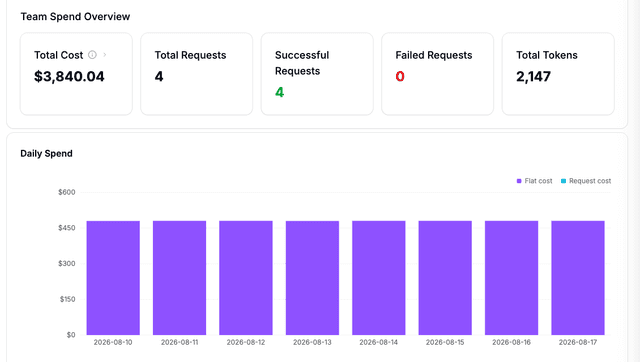
A deployment split with ptu_shares writes one row per team instead, each carrying that team's share in place of ptu_count: 30 and 20 of the 50 PTUs at $1 per PTU-hour are $720 and $480 for a full day, and the deployment's $1,200 lands on nobody else. Active hours are the overlap between the day and the reservation window, so a reservation starting at noon accrues 12 hours on its first day and 24 thereafter. The rows are written into LiteLLM_DailyTeamSpend under the reserved key __ptu_flat_cost__, which keeps flat cost separate from the per-request spend recorded against real API keys.
A reservation that starts before the job first sees it is filled in as well: the catch-up pass prices each elapsed day back to ptu_effective_from, up to 91 days. A deployment configured today with a backdated start therefore accrues its whole window on the first run. A day the job has already priced keeps its rows when shares later move between teams, so the team taking over a share is billed only for days priced after the move, never for days the previous holder already paid for. A day whose write fails is written for none of its teams, and the next catch-up pass prices it for all of them. The job splits a day by the shares as they stand when it runs, so shares moved during a day bill that whole day by the new split.
Flat cost does not count against team or key budgets. Reserved capacity is already paid for, so a team cannot exhaust a budget by using the capacity it reserved.
Spillover requests
When a PTU deployment is full, Azure can send the overflow to a pay-as-you-go deployment you configure as its spillover target, and bills those requests per token. LiteLLM does the same: a response with x-ms-is-spilled-over: true is priced at the served model's standard rates, while requests the PTU serves stay at zero. The hourly flat cost is unchanged either way
Spilled requests are tagged in the spend log metadata, so you can tell them apart on the Logs page:
"azure_spillover": {"from_deployment": "<your-deployment-name>"}
This needs LITELLM_ENABLE_PTU_COST_ATTRIBUTION set and a pricing map entry for the served model (set base_model if the deployment name does not match one). Without either, spilled requests still log at zero
Read the cost back
/team/daily/activity reports flat_cost per day and total_flat_cost for the range, alongside the usual per-token spend, and ptu_hours next to the tokens: on each day, on each PTU model group and the API keys under it, and as total_ptu_hours for the range. PTU-hours are the team's prompt, cached, and completion tokens converted through the model's sizing row, so a team can compare what it consumed with what it reserved. A day's tokens are sized only by a reservation whose ptu_effective_from to ptu_effective_to window covers that day, so usage before a reservation starts or after it ends reads no PTU-hours. Each team's row under breakdown.entities keeps ptu_hours at 0, since that row carries no model group to size by, so read one team's PTU-hours from a request naming only that team:
curl -s "http://localhost:4000/team/daily/activity?team_ids=<team-id>&start_date=2026-01-01&end_date=2026-01-31" \
  -H "Authorization: Bearer $LITELLM_MASTER_KEY" | jq '{
    total_spend: .metadata.total_spend,
    total_flat_cost: .metadata.total_flat_cost,
    total_ptu_hours: .metadata.total_ptu_hours,
    gpt41_ptu_hours: [.results[].breakdown.model_groups["gpt-4.1-ptu"].metrics.ptu_hours]
  }'
The Usage page in the Admin UI shows the same figures under Team Usage, charting flat cost separately from request cost, with a PTU Hours tile for a team whose window consumed any, and CSV export carries them:
Rates you must not set
LiteLLM refuses a per-token, per-second, or cache rate on a PTU deployment, and names the field it rejected. Sending 0, an all-zero table, or no value at all is accepted:
A PTU deployment bills by reserved capacity, so input_cost_per_token cannot be charged on top
of it. Send 0 or no value, or remove ptu_count and cost_per_ptu_per_hour to bill per token.
A rate already stored on a deployment when you add PTU configuration is zeroed rather than refused, so a deployment priced before the feature was enabled heals on its next save. Removing ptu_count and cost_per_ptu_per_hour releases those zeros, and the deployment goes back to billing per token.
Web search rates are handled the same way. Note that xAI models bill their list price per search call regardless, because their pricing reader ignores a zero rate.
Limitations
The legacy POST /model/update does not run the rules above, so a PTU deployment configured through it keeps billing per token and never accrues flat cost. Use POST /model/new, PATCH /model/{model_id}/update, the Admin UI, or config.yaml
The Python Router used on its own zeroes per-token pricing at registration, but nothing schedules the daily job outside the proxy, so flat cost is not accrued there
PTU-hours are reported on team activity only. The per-key, per-user, and per-tag activity routes carry no model group in their rows today, so they report none
A request that names a shared deployment by an alias, a routing group, its deployment id, or its provider model lands in a usage row keyed by that name. On one team's page the row is sized by the deployment that team is served from behind the name, its shared one first and never one reserved for another team, so its PTU-hours count the same as a request naming the model group and a team with no share on a name, or served by an open deployment next to another team's reservation, reads no PTU-hours on it. A page spanning several or all teams sizes the row by the first reserved deployment behind the name
An unshared deployment in the same model group as a shared one counts toward the teams' ceilings and PTU-hours on that group, and a group mixing models is sized on one team's page by the deployment that team holds its share on and on a page spanning teams by its first reserved deployment's row. Keep a shared deployment in a model group of its own
ptu_shares is edited through POST /model/new, PATCH /model/{model_id}/update, or config.yaml; the model form in the Admin UI has no shares editor yet