May Townhall Updates: Security Hardening, Release Versioning, and the Agent Platform


Thank you to everyone who joined our May town hall.
We covered security hardening, release versioning changes, new product launches (MCP toolsets, on-behalf-of OAuth), performance wins, and our biggest bet yet, the LiteLLM Agent Platform.
Security updates
v1.84.1 ships the security hardening
All security fixes from the last 4 weeks are bundled in v1.84.1, a patch on top of v1.84.0. Upgrade when you can.
pip install --upgrade litellm
- Backwards-compatible with v1.83.x configs.
- New release versioning scheme (see below).
Bug bounty: now live
We now pay for security reports.
- Scope — the LiteLLM gateway and SDK.
- Submit via private vulnerability report on GitHub.
- Triaged by maintainers and Veria Labs security team.
Automated security review on every PR
Every PR now gets an automated security pass via Veria AI + zizmor + semgrep. Look for the Veria scan; it's a required check. False positives are flagged, never blocking.
Last 4 weeks: by the numbers
| Metric | Count |
|---|---|
| Vulnerabilities patched | 89 |
| Reported by Veria scanner | 78 |
| GHSAs fixed | 58 |
| GHSAs closed | 96 |
All fixes ship in v1.84.1.
What's next for security
- Improve GHSA triage and validation process.
- Further CI pipeline improvements.
- Add zizmor to sister projects (project-releaser).
- Define support window for prior releases.
Stability updates
Release versioning: the problem
Too many version suffixes: -nightly, -dev, -stable, -stable-patch. Weekly stable bumps left no room for hotfixes, and users filtering -stable in search still had to wade through releases.
New versioning from v1.84.0
Release versions are now consistent across PyPI and Docker.
- No more
-stable— stable releases follow PEP-440 / SemVer 2.0. They now read asv1.84.0. - Minor bumps weekly — each scheduled stable release bumps the MINOR version, not PATCH.
- Patch for hotfixes — when
v1.84.0needs a fix, it becomesv1.84.1.
What's next for stability
- EKS multi-pod internal deployment.
- Catch deployment regressions and Claude Code changes.
- Higher code coverage: 70% on 5 hotspot regression files.
- Goal: minimal regressions per stable release.
Product updates
What we launched
Routing & Memory
- Adaptive Routing
- Memory Management (beta)
- Prompt Compression
MCP
- MCP Toolsets
- On-behalf-of MCP OAuth
Quality & Safety
- LLM-as-a-judge guardrails
- Skills Marketplace
MCP Toolsets
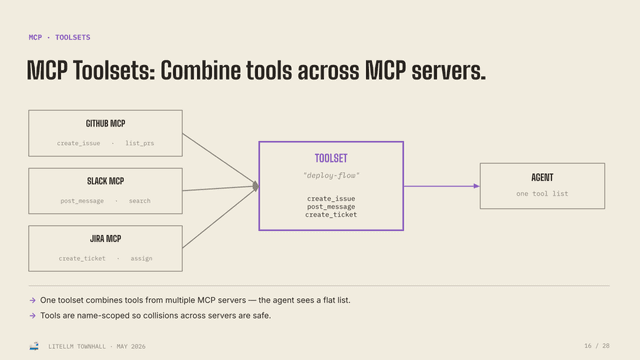
MCP Toolsets let you combine tools across multiple MCP servers into a single flat list. An agent sees one tool list instead of juggling multiple servers.
Tools are name-scoped, so collisions across servers are safe.
Example: A "deploy-flow" toolset might combine create_issue from GitHub MCP, post_message from Slack MCP, and create_ticket from Jira MCP, all surfaced to the agent as one tool list.
MCP on-behalf-of OAuth
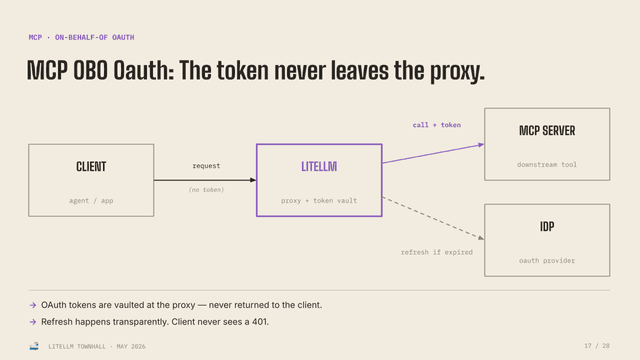
OAuth tokens are vaulted at the proxy and never returned to the client.
- The client sends requests without a token.
- LiteLLM adds the token when calling the downstream MCP server.
- Refresh happens transparently. The client never sees a 401.
What's next for product
- MCP: store static user credentials.
- Claude Code: auto-update header compatibility chart.
- Reasoning level support across models and providers.
- Full Bedrock Converse support in Claude Code.
Performance wins
20% RPS + TPM improvement
Streaming /chat/completions now handles 20% more requests per second and tokens per minute.
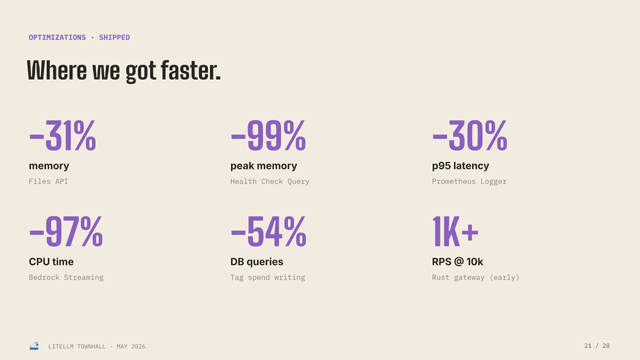
Shipped optimizations
What's next for performance
- Rust migration in flight: stable 1K+ RPS at 10k concurrency.
- Focus on reducing gateway overhead under high load.
- Tracking: TTFT, TPM (streaming); RPS, overhead % of E2E (non-streaming).
Product roadmap: the LiteLLM Agent Platform
Our bet
We believe 80% of AI workloads will be agents within the next 3 years.
Signals we're seeing:
- OpenClaw usage explosion
- Enterprise asks shifting from chat to agents
- Claude Code adoption tracking up
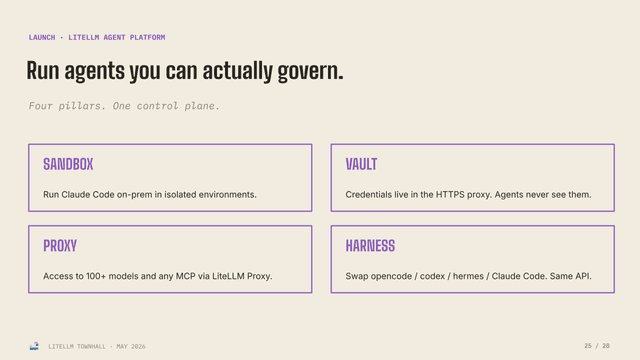
LiteLLM Agent Platform: run agents you can actually govern
Four pillars. One control plane.
- Agent Templates: pre-built configs for common tasks.
- Skills: upload and reuse skills across agents.
- Projects: repos + env vars, packaged for reuse.
What's next
Thank you again for all the questions and feedback. We'll keep sharing concrete progress updates as these efforts ship.
Hiring
We are actively hiring across several roles. Apply here if you're interested!