
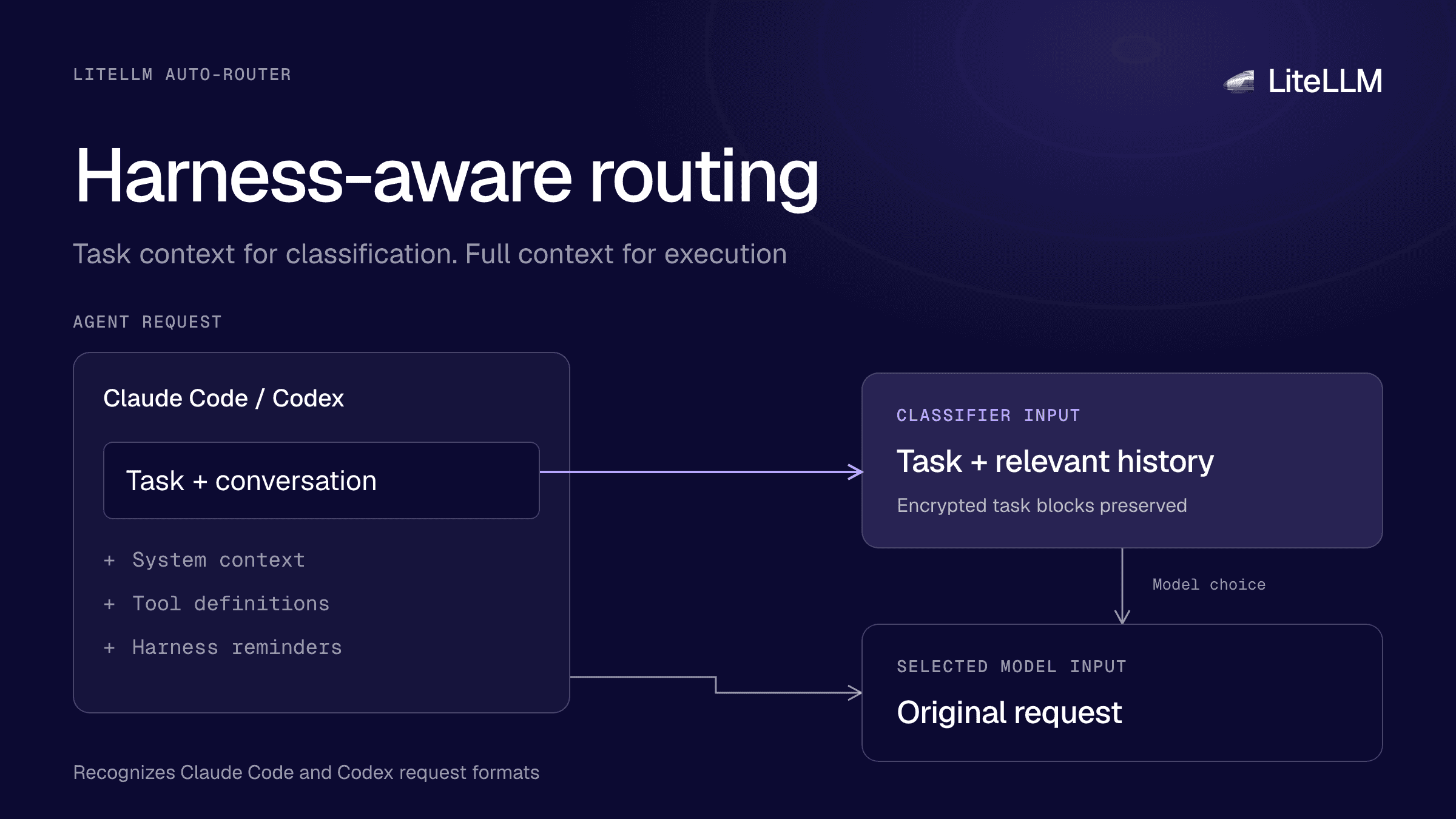
We've updated the Auto-Router to account for how Claude Code and Codex package requests. It now removes more harness context from classification, preserves encrypted delegated tasks, and shows exactly what the classifier received
Work with the LiteLLM team to test routing on your production traffic and help shape what we build next
Apply to Become a Design PartnerA coding harness sends more than the user's task. Requests also carry environment details, repository instructions, skill catalogs, and reminders. Those can dominate the classifier input or appear after the task as a separate message. Harness-aware routing uses the client identity and request format to find the task that needs a model
| Update | What changes |
|---|---|
| Claude Code classification | Omits caller system text from the classifier input |
| Codex reminder handling | Removes recognized harness blocks while preserving the delegated task |
| Encrypted delegated tasks | Preserves encrypted task blocks in native Responses classifier calls |
| Classifier logs | Separates classifier input, masked source request, and classifier response |
Less classifier input for Claude Code
In a Claude Code reproduction, a short binary-search question used 2,478 classifier input tokens. Environment details, agent definitions, and the skill catalog accounted for 7,613 characters in the classifier's user payload
For recognized Claude Code requests, the LLM classifier now omits caller system text. The selected model still receives the original system text, and the classifier keeps the current ask, configured prior turns, and conversation-depth signal
| First classifier call | Before | After |
|---|---|---|
| User payload, characters | 7,675 | 62 |
| Total input tokens | 2,478 | 524 |
That's about 79% fewer classifier input tokens on this call. The reproduction used Claude Code 2.1.268, a Haiku 4.5 classifier, and a three-turn session with one delegated subagent. It measures classifier overhead on that first call; total session cost and answer quality need separate evaluation. Reproduction and results
Task constraints supplied only in Claude Code system messages also stop influencing tier selection. Put constraints that should affect routing in the task itself
Keep the Codex task in view
Codex can append environment and repository instructions after a delegated task. Previously, that trailing message could become the classifier's current ask
For recognized Codex user agents, the router now strips complete harness blocks such as <environment_context> and <recommended_plugins>, plus the repository instruction envelope. The delegated task stays available for classification, and the selected model receives the original request
With classification_mode: user_turn and a session identifier, a fresh ask followed by reminder text gets classified. Subsequent assistant or tool continuations reuse its selected model without another classifier call. A new ask remains eligible for classification. Behavior and reproduction
Custom reminder_markers replace the built-in markers, so include every pair your harness needs when overriding them
Classify encrypted delegated tasks
Some Codex delegated tasks arrive in an agent_message containing encrypted_content. Converting that payload to ordinary text hid the task from the classifier and produced a SIMPLE verdict for a difficult request
The router now preserves the encrypted task in a native Responses classifier call. In the reproduction, the difficult task changed from SIMPLE on gpt-5.6-luna to REASONING on gpt-6-astra. The easy task stayed SIMPLE on gpt-5.6-luna, with both streaming and non-streaming requests tested. Reproduction and results
This requires a native OpenAI or Azure OpenAI Responses classifier deployment with credentials that can consume the encrypted content. Encrypted tasks bypass the local scoring shortcut in heuristic_first and hybrid modes. Unsupported deployments and decryption errors follow classifier_fallback. The live reproduction used OpenAI; Azure transport was not exercised
See what the classifier received
Open a request in Logs, then select its Classify row. New captures show Classifier input, Originating request, credentials masked, and Classifier response separately
This makes it possible to check whether the task reached the classifier and compare its verdict with the original request. Credentials, including Cookie and Set-Cookie headers, are masked in the source copy. Message-logging redaction settings still apply, and older rows retain their existing view. Logs update
Try it with your harness
Use a build containing the linked changes and send Claude Code or Codex traffic through the Auto-Router. Preserve the client's User-Agent header so the router can recognize it. Test Claude Code behavior through the real client: the browser routing preview has no client-identity field and uses generic classification behavior
Share what you find in the Auto-Router discussion