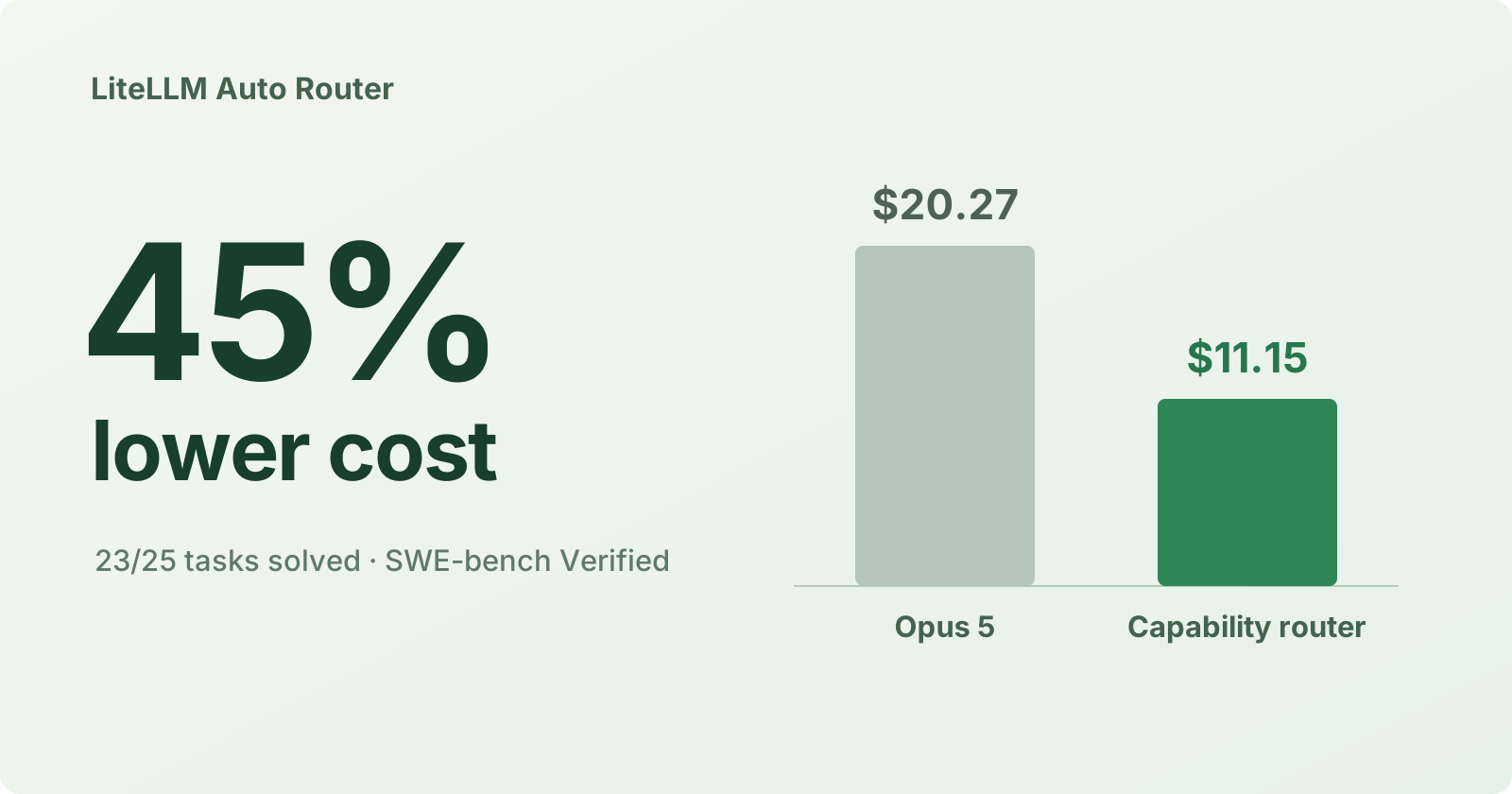


We solved 23 of 25 SWE-bench Verified tasks with LiteLLM's experimental capability router for $11.15. With Opus 5 for all solver calls, we solved 23 tasks for $20.27. We spent 45% less, including classifier calls, with prompt caching on in both runs.
Get early access and work with the LiteLLM team on routing for your production traffic.
Apply to Become a Design PartnerShare your results in discussion #32168.
Results
We compare four configurations on the same 25 tasks. We measure quality by solve rate and include unsuccessful attempts and classifier calls in total cost.
| Configuration | Tasks solved | Solve rate | Total cost | Cost / solved task |
|---|---|---|---|---|
| LiteLLM capability router | 23/25 | 92% | $11.15 | $0.48 |
| Opus 5 | 23/25 | 92% | $20.27 | $0.88 |
| Sonnet 5 | 22/25 | 88% | $13.19 | $0.60 |
| NeMo Switchyard | 21/25 | 84% | $17.03 | $0.81 |
Cost per solved task divides total run cost by the number of solved tasks.
- 45% lower cost than Opus 5 at the same solve count. We solved 23/25 tasks in each run, spending $11.15 with capability routing versus $20.27 with Opus 5.
- One more task solved than Sonnet 5, for $2.04 less. We solved 23/25 tasks with capability routing versus 22/25 with Sonnet 5.
- Two more tasks solved than NeMo Switchyard, for $5.88 less. We reached a 92% solve rate with LiteLLM capability routing versus 84% with Switchyard.
Routing between Sonnet and Opus
We classify the task before choosing a model. We send GPT-5.4-mini the opening instruction, any latest user follow-up, and a capability checklist. We ask it to identify the hardest requirement and estimate Sonnet 5's chance of completing the whole task, using signals such as clear requirements, available inputs, and executable checks.
We compare that probability with the threshold for the task's capability category, requiring a higher probability for uncertain or unsupported tasks. We choose Sonnet 5 when the estimate meets the threshold and Opus 5 when it falls below.
In this run, we sent 98.4% of solver calls to Sonnet 5 and 1.6% to Opus 5.
Benchmark setup
We used the same Harbor and mini-swe-agent setup for each configuration: the same 25 SWE-bench Verified tasks, one attempt per task, three concurrent tasks, and the same verifier. We enabled prompt caching in each run and measured total cost from LiteLLM gateway spend logs, including classifier and judge calls.
Scope of the result
We matched the Opus solve count on this subset, with different successes and failures: we solved 21 tasks in both runs, plus two distinct tasks in each. With 25 tasks and one attempt per configuration, we cannot establish equal quality across workloads or predict savings for your agent.
For a comparison on your workload, use the same tasks and verifier, enable prompt caching across configurations, and include classifier spend in the total.
For related experiments, read Prompt Caching Works with Auto Router and Subtask-Specific Routing: Same Quality, 46% Less Cost.
An experimental classifier
Capability forecasting is an experimental approach to Auto Router. It estimates whether a cheaper model can complete a task using the requirements, available information, and verification tools. We are evaluating this idea and how it can work with complexity assessment
Work with the LiteLLM team to evaluate Auto Router on your production traffic.
Apply to Become a Design Partner